
What Holds Empires Together
Roman concrete grows stronger in the sea over the centuries. An essay on what that reveals about empires, about Alexander, Rome and Byzantium, and about what it means for us.
Four essays on what carries societies, then and now: what holds empires together, what remains when they fall, whether we are losing the ability to correct ourselves, and to whom power still has to answer today. The other parts will appear in the coming weeks and will be linked here.
Alexander’s empire fell apart almost as soon as he was dead. The Roman Empire lasted around five hundred years in the West and almost fifteen hundred in the East. Why that was is one of the oldest questions in the writing of history.
For me, questions like this rarely end with a moment’s thought. When one gets hold of me, it quickly turns into an urgent need to get to the bottom of it: I read, compare and discard until I reach a point of saturation, or at least until it is clear where the answer ends.
That this particular question will not let go of me has to do with what I usually write about here: what holds a person up when things get serious, and what breaks them. Resilience always grows “both within the individual and in community”, and in this series I ask the same question on a larger scale. I am interested in history less for its own sake than for what it tells us about ourselves today.
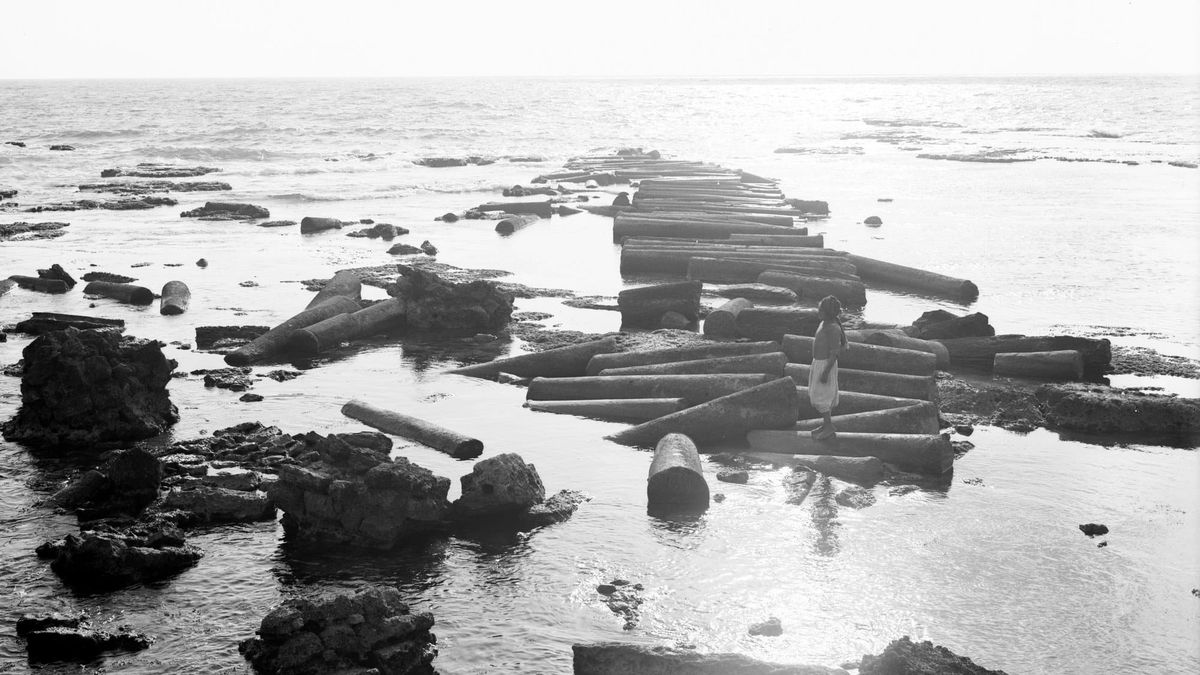
Part of the answer lies in the sea off Caesarea, on the coast of present-day Israel. Shortly before the turn of the era, Herod had one of the largest artificial harbors of his time built out into the open sea there, using Roman concrete, for which shiploads of volcanic ash were brought from the Gulf of Naples. Remains of its moles, the breakwaters that protected the harbor basin from the surf, still lie in the sea today.
Modern reinforced concrete often begins to deteriorate in salt water after only a few decades, because the sea makes its steel reinforcement rust. The Roman kind grew stronger over the centuries, because the seawater seeping into it dissolves components of the ash and lets new crystals grow in its pores, interlocking the material instead of breaking it apart. How exactly this happens has only been known since 2017, from drill cores that a team led by the geologist Marie Jackson took from Roman harbor structures. That it happens was already known to Pliny the Elder, who marveled in the first century at how the dust from the hills of Puteoli, once plunged into the sea, became a single stone, impregnable to the waves and stronger every day.
A building material made stronger by what attacks it: the image shifts the question. An empire does not last because it is hard. What carries it instead becomes visible when you set empires side by side that lasted for very different lengths of time.
Alexander: an empire that hung on one man
Babylon, June 323 BC. Alexander lies in fever, thirty-two years old, master of a territory that stretches from Greece to the Indus and that he conquered in little more than a decade. He has not named a successor. His half-brother is considered unfit to rule; his son has not yet been born.
The historian Diodorus records that his companions asked him on his deathbed to whom he was leaving the empire, and that he answered: “To the strongest.” Whether he said it is uncertain; according to other accounts, by the end he could no longer speak. The sentence survived because it describes exactly what followed: for forty years his generals waged war on one another, his half-brother, widow and son were murdered, and what had been an empire broke apart into the kingdoms of the Ptolemies, the Seleucids and the Antigonids.
Elsewhere I have written about Alexander and Hephaestion, about a man who lost his footing when his friend died. “The world was large enough for Alexander’s victories. For his loss, it was too small,” it says there. His empire was much the same: it hung on him. There was an army that followed him, but no order that would have held without him. How literally this can be taken is shown by the fight over his body: Ptolemy had the funeral procession intercepted on its way to Macedonia and taken to Egypt, because whoever possessed the dead king could present himself as his heir.
Even so, this empire did not vanish entirely. For centuries Greek remained the common language from Egypt to present-day Afghanistan, and Alexandria became home to the most famous library of the ancient world. What Alexander could not hold together politically held far longer culturally.
Rome: an empire that gave people a stake
I have been to Rome twice, as a child and later as an adult. As a child, the city seemed overwhelming to me. The second time, in daylight between cars and tourists, I could only catch a glimpse of its grandeur.
A glimpse is not a bad word for what remains of an empire. And the obvious explanation for Rome’s longevity, that it was simply more powerful, more disciplined and more uncompromising than others, misses the point. Rome did not last because it stayed strong, but because it changed again and again, even when its very existence was at stake.
The answer lies less in the legions than in the institutions. Rome conquered, but it also integrated. Over generations, the subjugated became allies, allies became local elites, and elites became Roman citizens. With Emperor Caracalla’s Constitutio Antoniniana, this system of graded belonging reached a provisional end point in 212: citizenship for almost all free inhabitants of the empire. The logic behind it was simple and effective at once. Give people a stake, and you will have to fight them less often.
I live in Vienna, and this sentence makes me think of my own city. In the 2025 Vienna city council election, more than a third of the people over 16 who live here were not allowed to vote because they do not hold Austrian citizenship. Across Austria, it was just under a fifth in the 2024 parliamentary election, and in Germany around ten million adults have no vote in elections to the Bundestag, the federal parliament. Roman citizenship was not a right to vote in today’s sense, and I have no wish to romanticize Rome. But Rome had understood what it costs to leave people outside for good who have long been part of the whole.
Added to this was a pragmatism that does not fit the cliché of a rigid empire. Rome adopted Greek philosophy, foreign gods and local forms of administration when they worked, and showed remarkably little ideological reluctance in doing so. Where the system reached its limits, it reformed itself. The clearest example is the crisis of the third century, roughly from 235 to 284. Emperors were murdered one after another, generals rebelled, and for a time the empire broke apart into separate realms. Diocletian ended this crisis by fundamentally rebuilding the administration, the tax system and the army instead of returning to the old ways.
Rome could be very sick without dying right away.
Honesty requires the other half. Rome granted citizenship to Gauls, Iberians and Syrians while running a slave economy on which a considerable part of its agriculture and mining depended. For Italy in the early imperial period, some estimates put the share of enslaved people at up to a third of the population; others are considerably lower. Integration and violence did not follow one another; they ran side by side. The same machine that handed out citizenship also produced those who would never receive it. Whoever plays Rome off against other empires easily turns a more successful empire into a morally better one.
And size had its price, which grew over time. An empire needs a standing army, the army needs pay, the pay needs taxes, and the taxes need a growing bureaucracy to collect them. The borders grew longer, the emperors more dependent on their military commanders, the succession less stable, until the very qualities that had made Rome great became a burden themselves. “The bigger we get, the stronger we are” slowly, almost imperceptibly, became “the bigger we get, the more energy we need just to hold ourselves together.” In the West, the empire ended in 476, after a long stretch in which it had failed to change in time.
Byzantium: an empire that transformed itself
When Constantinople fell to the Ottomans on May 29, 1453, an emperor died defending it who called himself Emperor of the Romans, even though he spoke Greek, was a Christian, and Rome itself had not belonged to his empire for centuries. The name Byzantium was given to it only later. Its inhabitants called themselves Romans to the very end, and they had reason to: it was the Roman Empire continuing in the East, for almost a thousand years.
Yet almost everything that had once defined Rome had changed. The capital lay on the Bosporus, the religion was Christian, and in the seventh century, as Greek replaced Latin as the language of administration, the empire also lost Syria, Egypt and later North Africa, its richest provinces, to the Arab expansion. In 1204, crusaders conquered and plundered Constantinople. The empire broke apart into successor states, and in 1261 one of them took the city back.
More revealing than the tenacity of Byzantium is the question it raises: how much can change in an empire for it still to be the same? Language, faith, borders and enemies had all changed. What remained was Roman law, an administration that could collect taxes and pass on knowledge, and the conviction of being Rome.
How long this conviction held is shown by a memory of the Byzantinist Peter Charanis, who grew up on the island of Lemnos. When Greek soldiers took over the island from the Ottomans in 1912, the village children ran together to look at them. “What are you looking at?” one of the soldiers asked. “Hellenes,” the children said. “Aren’t you Hellenes yourselves?” “No, we are Romans.” That was 459 years after the fall of Constantinople and more than fourteen centuries after the end of the empire in the West. It describes endurance more precisely than any image of solidity: something can go on telling itself as the same while it changes, and it can do so for longer than any wall stands.
I know this question from my own life, too. After the things that broke me, I have become someone else in many ways, and still I tell my story as the same person. Identity is changeable, and that is precisely what holds it together.
The Aztecs and the Inca: empires that ran out of time
The counterpart lies on the other side of the Atlantic. The Aztec Triple Alliance, founded in 1428, ruled over subjugated city-states mainly through tribute and fear, never through anything resembling Roman citizenship. When Cortés landed in 1519, he therefore quickly found allies: tributary peoples such as the Totonacs, who wanted to be rid of their levies, and the Tlaxcalans, who had never let themselves be subjugated and had been hostile to the Aztecs for decades. But something else was decisive. A smallpox epidemic, brought in by the Spanish in 1520, also killed Moctezuma’s successor after only about eighty days in office, and when Tenochtitlan fell in 1521, the city had already been bled dry.
In the Inca Empire, the epidemic was an even more direct cause. The ruler Huayna Cápac died around 1527, probably of smallpox, together with his designated successor, and a civil war broke out among his sons that had just been decided when Pizarro arrived in 1532. Without this civil war, a handful of Spanish soldiers could hardly have toppled an empire of that size.
Rome knew epidemics too, including a devastating one in the middle of the third-century crisis. But the diseases that came with the Spanish struck people with no immunity at all and killed most of the population in some regions, and no Roman emperor ever had to withstand an epidemic of that scale and an invasion at the same time. What can still be said is this: the Triple Alliance had subjects where Rome had people with a stake in it, and when the blow came, they defected.
What the comparison shows
Set side by side, the four cases say less about strength than about what carries an empire through a crisis. Where no one knew who would decide after the ruler, everything hung on a single life: Alexander had no answer to that, the Inca lost theirs to an epidemic, and Rome paid for its open succession in the third century with fifty years of civil war. Those who had given people a stake found allies when it counted; those who only took tribute found onlookers or enemies. And those who lasted longest were those who could rebuild themselves without giving themselves up, as Diocletian did, and Byzantium for centuries.
This order has a weak spot, though, and it deserves to be named: a solid case of survivorship bias. Explaining Rome’s survival by its capacity for change only works in hindsight, because Rome survived. There were certainly empires that proved just as adaptable and still went under, for reasons that had little to do with it, such as a battle lost at the wrong moment or a disease no one could have done anything about. The story is plausible, but also convenient, precisely because it is told after the fact. That makes it an interpretation, not proof. It is not a weak one, though, because the empires that fell apart early show the same pattern from the other side.
Behind it lies a second blind spot: all four cases measure endurance by the empire. At roughly the time the armies of the First Crusade were passing through Constantinople, a village called Oraibi came into being on a mesa in what is now Arizona; it is dated to around 1100. It is inhabited to this day, by Hopi whose ancestors never founded an empire, and it has by now existed longer than the Roman Empire lasted in the West, and almost ten times as long as the Inca Empire. In a comparison of empires, it does not appear at all.
The harbor that did not hold
The harbor of Caesarea itself did not hold, though. After only a century or two, the foundations of the outer moles gave way (exactly why is still disputed), and they sank to become reefs. Around the year 500, the emperor in Constantinople had the harbor repaired once more. After that it fell into ruin. The material endured. The structure would have needed an empire that looked after it.
It was not the recipe; that was never lost. Vitruvius describes it in his books on architecture, including the ash from the region around Puteoli that hardens under water, and these books went on being copied in the Middle Ages. What was lost was the skill: the quarries, the transport routes, the builders who knew how to mix it, and a state that commissioned such harbors and maintained them. Knowledge does not simply evaporate. It needs institutions that pass it on, and when they collapse, it disappears with them, often for centuries, even if the text is still on the shelf.
With that, the opening question can be answered: empires last as long as they can do what this concrete can do, namely turn what presses in on them into something that carries them. Strangers into citizens, crises into reforms, losses into a new form. And they fall when this capacity is exhausted, or when, as with the Aztecs and the Inca, no one gives them the time to develop it.
What remains open is how much of this can be passed on at all, and whether we would notice from the inside if it were coming to an end here, with us.
Originally published in German as “Was Weltreiche zusammenhält”. English version by Dorian Rammer, translated with AI assistance.
Even a small donation helps me set aside time for writing. Thank you.
Warm regards
Dorian Rammer