
Alexander and Hephaestion: The Second Self
A literary essay on Alexander the Great and Hephaestion: on power, companionship, the “second self,” and the moment when even an empire becomes too small for a single loss.
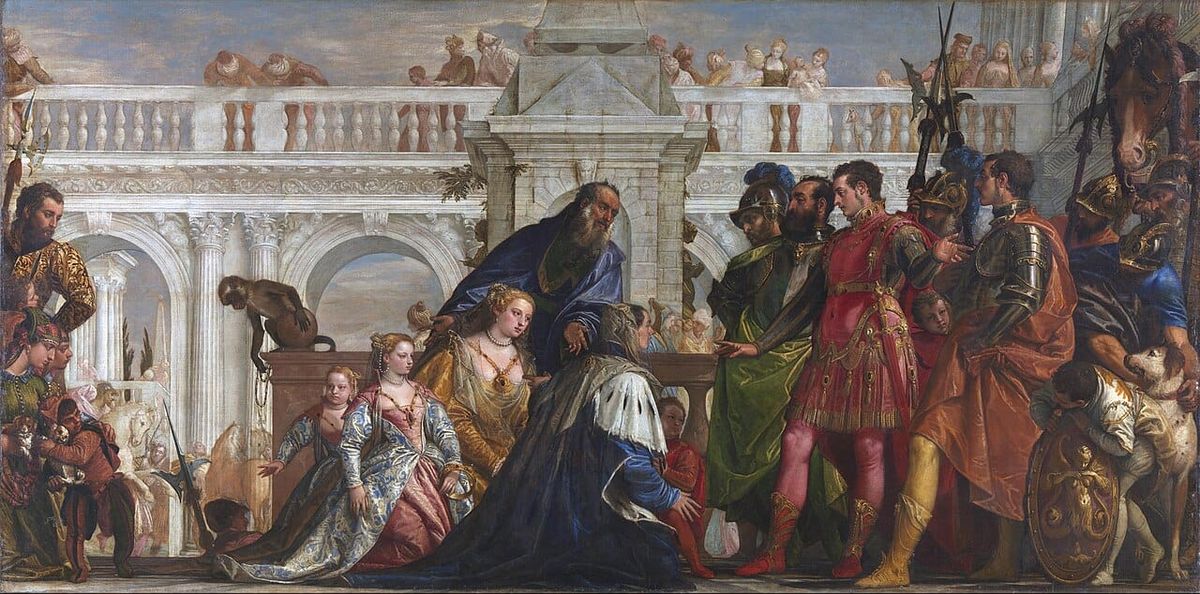
324 BC, Ecbatana. Alexander is sitting beside a bed.
Outside, the empire is waiting. Generals, messengers, satraps, a machine that can barely breathe without his will. Inside, Hephaestion lies in fever. His body is failing. The physicians are silent, with the faces of men who know the answer and are afraid of it.
The man who conquered Persia cannot defeat a fever.
This is the real humiliation of power: it reaches almost everywhere. Almost. Alexander can force his way across rivers, topple kings, have maps redrawn and cities named after himself. He can found a city in Egypt, leave the Persian Empire in ruins and let it be said that he is the son of Zeus-Ammon. But he cannot order this one body to go on living.
And it is exactly there – at this bed, in this room, in this helplessness – that Alexander is at his truest.
Not at Gaugamela. Not at Persepolis. Not on his entry into Babylon, which the people celebrated like a liberation. But here, in Ecbatana, where the most powerful man of his world keeps watch, and waits, and can do nothing.
Why this moment tells us more than all his victories combined is the real question of this essay.
He Too Is Alexander
There is one scene you have to know to understand Alexander. Not Gaugamela. Not the Gordian knot. This one:
After his victory over Darius, the Persian royal family becomes Alexander’s captive. Sisygambis, the mother of Darius, comes before the victor. She is looking for the king. She sees two men, dressed alike, takes the taller one for Alexander, and throws herself down before him.
But it is Hephaestion.
A mistake like this can humiliate, can upset the hierarchy, and in a world of courts can create instant distance. The real king would have every reason to correct the confusion and make the hierarchy visible.
Alexander corrects nothing.
What he says, in essence: You were not mistaken, Mother. He too is Alexander.
This is not a polite joke, not an elegant gesture of mercy. It is a sentence one person can only say about another if he places him not beside himself, but inside himself. He too is Alexander does not mean: he is close to me. It means: this person belongs to my identity. What I am carries him.
No other person in Alexander’s life ever drew this sentence from him.
Arrian records the scene and is careful to tell it neither as certain truth nor as mere invention. You can see why it survived: it shows Alexander’s bond with Hephaestion with a precision no later judgment can replace.
The Man Before the Myth
Hephaestion was almost the same age as Alexander. Both belonged to the Macedonian court, a world where Aristotle, Homer, weapons training and an education in kingship were woven together. Achilles and Patroclus were not mere literary figures. They were a model of how great loyalty, glory and the bond between men could be imagined. And both of them, Alexander and Hephaestion, knew each other from the time before Alexander eventually became a story.
That is crucial.
Because Alexander was boxed in early. Every gesture meant something. Every outburst of anger was read politically. Every act of mercy was diplomacy. Anyone who lives like this loses the right to be ordinary. He can no longer simply say what he thinks without it becoming world history. He can no longer be weak without empires beginning to tremble.
Hephaestion knew him before all that.
He knew the boy. The reader of Homer. The young Macedonian who believed in Achilles as a promise his own life would keep. He knew Alexander before Alexander became a symbol. And he remained one of the few people in whose presence Alexander did not first have to be great in order to be taken seriously.
That is a kind of power no office can grant. No victory wins it. No decree compels it. It grows only through time, through shared history, through the lived knowledge of what is inside a person before he has decided what he wants to become.
Hephaestion was that witness.
What Was This Love?
The wrong answer is to reach for a category right away.
Friendship. Brotherly love. Romance. Comradeship. Political alliance. All of these words are too narrow for what the sources suggest and for what Alexander’s reaction to Hephaestion’s death proves.
Antiquity knew other gradations between loyalty, admiration, physical intimacy, education and myth. Anyone who asks whether Alexander and Hephaestion were “really” a couple is putting a modern question to an ancient bond, and that is why no answer satisfies. Anyone who, on the other hand, writes every trace of physical intimacy out of this story makes it smaller than it was.
The ancient tradition made Hephaestion Alexander’s second self. And Aristotle, Alexander’s own teacher, had defined the true friend as “another self.” The phrase is no exaggeration. It is the most precise term antiquity found for a bond that exceeds our categories.
A second self is not the beloved person beside you.
It is the person without whom you are less complete as yourself.
This has little to do with romance, and even less with mere friendship. It is the kind of bond in which part of what holds you up is anchored in someone else’s body. In a body that can fall ill. That can die. Sometimes slowly. Sometimes overnight, in a room full of physicians you cannot even blame, because they are just as helpless.
Hephaestion carried something of Alexander that no one else could hold. And what happens when a bond breaks says more about it than anything it was called while it lasted.
The Architect of Dreams
Hephaestion was not Alexander’s shadow.
That is the second great misunderstanding about him. He is often turned into a side character, the favored follower, the great friend of the even greater man. The historical sources paint a different picture.
He was chiliarch, the second man in the empire. At Gaugamela he fought in Alexander’s innermost circle and was wounded. Later, after the Philotas affair, he rose to share command of the Companion cavalry – the elite horsemen who drove the Macedonian army forward like a clenched fist. At the mass wedding at Susa, Alexander’s vision of a fused world became a ceremony: Greeks and Persians, victors and vanquished, East and West in a new order. Hephaestion was among the grooms, married to a sister of Alexander’s own bride. Where Alexander was too impatient for the finer points of power, Hephaestion was the one sent to negotiate.
Alexander thought in world-sized gestures. Hephaestion gave those gestures form.
This is no side note. It is a closeness of a special kind: not mere affection, but work on the innermost project of another person’s life. Hephaestion did not stand in front of Alexander and say: Be less. He stood beside him and helped him make the impossible look real, at least for a while.
And after Hephaestion’s death? Alexander appointed no ordinary successor in his place. The unit was to go on bearing Hephaestion’s name. As if not even the military order were allowed to pretend that this loss could be replaced.
Ecbatana: The Rift
When Hephaestion dies, Alexander does not respond with restraint.
He orders mourning across the whole empire. He has the sacred fires in the temples put out. He sends messengers to the oracle of Ammon in the desert to ask whether Hephaestion may be worshipped as a hero or as a god. Diodorus writes that Alexander spared no effort and no expense to raise him to divine honors.
One can read this politically. A king turns private grief into public order. The explanation is correct. It just isn’t enough.
Alexander was not a sentimental man. He was precise in command, cold as a strategist, capable of merciless violence when he thought it necessary. Nothing in his life was soft. And yet he responds to this one death with a gesture beyond all proportion.
Not because he is staging it. But because his pain finds no smaller form.
Hephaestion’s death does not only strike Alexander’s heart. It strikes the way he had built his world. As long as Hephaestion lived, there was one person in Alexander’s life who held the bridge between the boy from Macedon and the man shaping himself into the ruler of the world. Between man and myth. Between who he was and who he had to become.
With Hephaestion, that bridge dies.
And suddenly Alexander stands alone in his own greatness. Everyone is there – generals, officers, admirers, lovers. But the one who knew who he really was is missing.
This is the true horror of Ecbatana. Not loneliness in the ordinary sense. But this: losing the part of yourself that was anchored in another body.
The Survivor
After Hephaestion’s death, Alexander becomes someone else.
The sources report fits of rage, paranoid suspicion, plans for new campaigns that sound megalomaniacal even by Alexander’s standards. Arabia. The western Mediterranean. One new horizon after another, new maps that still do not look enough like him.
This is not freedom. It is flight.
Sometimes a person keeps marching because he still has a goal. Sometimes he keeps marching because standing still would mean the loss catches up with him. Alexander, who conquered the world outside, runs from something inside after Hephaestion’s death.
Eight months later, he too is dead. Babylon. Fever. Rumors of poison. A body giving way.
Read as literature, the truth is plain: Alexander outlives Hephaestion only briefly because with the second self, the first one also lost its hold. The world had belonged to Alexander. But without Hephaestion, he had no home in it.
The Lineage of the Impossible
More than two thousand years later: Paris, Brussels, cheap hotel rooms, absinthe, letters too loud for the paper.
Paul Verlaine and Arthur Rimbaud share no empire. They share a language. And here, too, a closeness grows too large for the forms meant to hold it. Admiration turns into dependence. Inspiration turns into hunger. In the end a shot is fired in Brussels – Verlaine’s desperate attempt to end an intensity he could neither live without nor endure.
Alexander and Hephaestion are not Verlaine and Rimbaud. But they stand on the same line: people who looked to the other for more than company. A second existence. A reflection that shows more than mirrors usually show.
Montaigne may have written the most beautiful sentence for this, about his friendship with Étienne de La Boétie, after whose early death he never again had anyone so close: Parce que c’était lui, parce que c’était moi. Because it was he, because it was I.
No more. No less. No reason that could be rationalized. Only the fact of a bond that was larger than its explanation.
The Second Self
There are people who accompany us.
And there are people who keep something of us that we cannot hold on our own.
That is the difference.
Whoever accompanies us is there when we need them. Whoever keeps something of us carries the knowledge of how our life hangs together: the inner pain behind the outer splendor, the boy behind the king, the fear behind the courage. Whoever accompanies us can be replaced, even if it hurts. Whoever knows our inner core leaves a hole in us when they die.
Hephaestion knew Alexander’s core.
Like every great closeness, this one had its imbalances of power, its shadows, its incompleteness. But he held something no one else could hold: the witness. The memory. The person who still knew what Alexander was like before he belonged on a throne.
That is why Ecbatana does not only break Alexander’s heart.
It breaks the way he understood the world.
As long as Hephaestion lived, Alexander could stop being Alexander the Great in his presence. He was recognized without reference to Gaugamela, without reference to Persia. Simply because he was Alexander. That may be the most radical intimacy there is: to be seen when the splendor falls away.
Alexander had an empire.
But in Hephaestion he had something rarer.
In Ecbatana, on that autumn day in 324 BC, it is not only Hephaestion who dies.
What dies is the part of Alexander that could still believe a single other person can make the world less infinite.
The king can command. The conqueror can take. The myth can survive.
The man loses.
And that is exactly why this story endures. Because it shows that people reach for absolute closeness anyway. Against all reason. Against all order. Against the plain fact that every body in which part of us is anchored is going to die.
The world was large enough for Alexander’s victories.
For his loss, it was too small.
Originally published in German as “Alexander und Hephaistion – Das zweite Selbst”. English version by Dorian Rammer, translated with AI assistance.
Even a small donation helps me set aside time for writing. Thank you.
Warm regards
Dorian Rammer