The Fist Comes Last.
Violence rarely begins with the fist. This essay asks what happens before it – and lays it bare: shame, dysregulation, missing co-regulation, group pressure. And why prevention has to begin earlier than punishment and headlines.
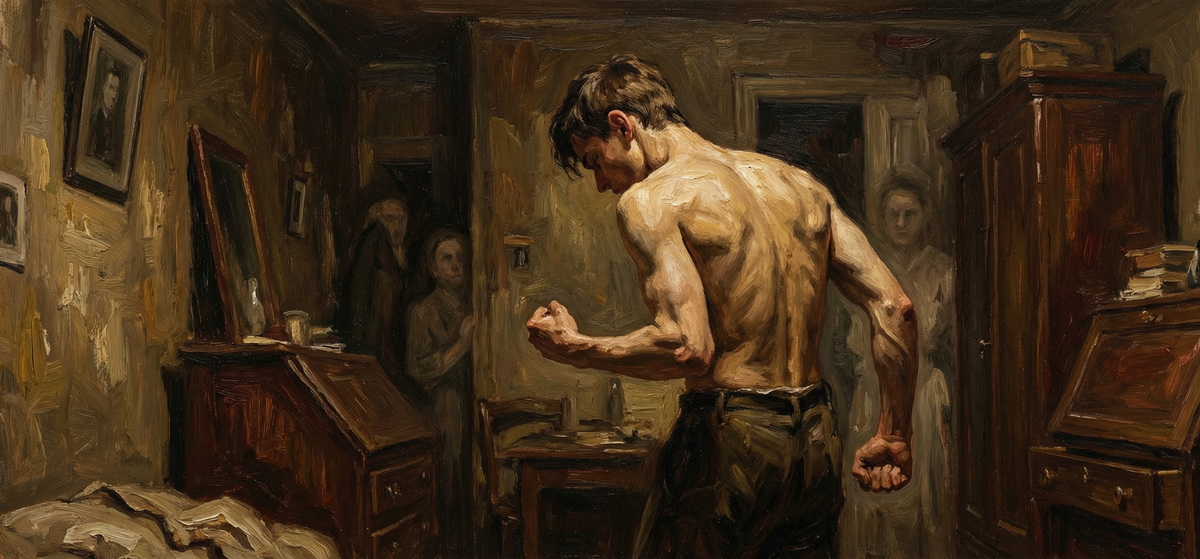
Sooner or later, a fist flies. And then it’s all anyone talks about.
Which game the boy played, which film he watched, where he picked it up. People look for the final trigger, that one clean cause. That is rarely an entirely wrong question, but it is almost always one asked too late.
Most of the time there was someone who had simply been too loud for a long time. Who was already shouting before he ever struck. Who insulted before he got physical, and who ruled at home through volume and threat alone. For a long time that tends to pass as temperament, or as being direct. But it is neither. It is dysregulation that never had consequences and therefore stayed – until, at some point, verbal discharge is no longer enough.
In reality, aggression is rarely a sudden explosion. Usually something has been building up for ages. But before we can understand why it escalates, we have to look at what aggression is actually meant for by nature. It protects, sets boundaries, defends status and signals very clearly: this far and no further. That is its original logic. But when it remains the only tool, because all the others were never learned, it becomes destructive.
Children who learn early that talking gets them nowhere, that requests are ignored and that calm is mistaken for invisibility, learn a simple lesson: volume works, physicality works. Intimidation works. That is not a broken character, but plain learning under the conditions that happened to be there.
Here we need to make a distinction that almost never comes up in the debates, even though everything depends on it:
The first aggressive type is completely flooded. His nervous system has been running in the red for years, because he never learned how to truly calm down. When he is provoked, there is no stable foundation. The reaction is there before the thought arrives. Not out of cool calculation – more out of the opposite. He is often exhausted by himself and knows he has gone too far, sometimes while the fist is still in the air. Then comes the shame, and then everything charges up again. The cycle keeps itself running.
The second type calculates. He uses threats or violence because he has learned that he gets away with it. He often stays remarkably cool while doing so. What looks like blunt brutality from the outside is pragmatism to him. Empathy isn’t necessarily missing; it is simply pushed aside, functionally, whenever it gets in the way. He is harder to reach, because his aggression doesn’t come from a loss of control, but from control.
From the outside the two sometimes look the same. But the causes are completely different, and our responses have to be too. Anyone who meets both with the same measures will achieve nothing with either.
Then there is shame. It is probably the most underestimated emotion when it comes to violence.
Guilt says: I did something wrong. Shame says: I am wrong. That is a massive difference, because guilt can, in principle, be repaired. After all, you can apologize, make amends and start over. Shame doesn’t allow for that. It doesn’t attack the behavior, but the person directly. And when you are attacked as a person, you go on the defensive.
Our limbic system – the old part of the brain responsible for detecting threats and for emotional reactions – often processes social humiliation as something almost as existential as a real physical attack. Anyone who has ever been exposed and humiliated in front of others knows how that feels, physically, in the pit of the stomach. Following this inner logic, aggression is then the counterattack.
It becomes especially volatile among boys. Unfortunately, they often learn early that shame is not something you show. That trembling is dangerous. But when a feeling finds no way inward, it looks for one outward. Not as a fist right away. First in the tone of voice, in a look, or in the way someone takes up space and makes it immediately clear who is in charge. The tragedy is that this mechanism is passed down through generations – from fathers who never learned to deal with shame themselves to sons who are not learning it now either.
And then groups come into it.
Youth violence rarely happens in a vacuum; it happens in front of an audience. And that changes everything. What two people might still have settled with words escalates as soon as others are watching. It is this collective sweating under observation, this panicked clinging to status, because the alternative would be social devaluation. Anyone who backs down often carries the stigma of the weakling for a long time. Prevention that only wants to fix the individual child misses reality.
Anyone who knows the framework from my earlier essay on how everyday life shapes us as political beings will already suspect it: nervous systems that are overstimulated early and persistently tend to develop poor impulse control and low frustration tolerance. That is not simply innate. It is an adaptation to the environment. Anyone who never learned to sit with that restless feeling in their own body knows no brakes in the moment of provocation. The moment in which pausing would be wise is over before it was even noticed.
This is where co-regulation comes in. An unwieldy term, but from a developmental perspective the most important thing of all. Children do not learn by themselves how to calm down, and certainly not by being told off. They learn it by having an adult beside them who stays calm. A calm body next to an agitated one – that is neurobiology: through processes of resonance, the child orients itself to the adult’s voice, facial expression, posture, breathing and inner stability. You have to have been calmed before you can calm yourself. Anyone who lacks that carries a structural gap. At best it shows up as chronic tension. At worst as what eventually ends up in court.
My own childhood was marked by violence and conflict – I experienced it in my own body, but also simply all around me, as a constant atmosphere. Changing or entirely absent caregivers, insecure attachments, and a psychological pressure that a child has no way of making sense of. The people who could have given me the words for it were, sadly, often part of the problem themselves.
What I didn’t learn was how to bear this inner restlessness without immediately making it go away. Nobody taught me, because the others couldn’t do it themselves. Not out of malice, but out of genuine inability.
And that is still one of the harder places I am working on today: impulse control – that is, not immediately taking inner urges for truth or for a mandate. Sometimes there is a pressure in the body that wants a quick solution: to say something, do something, take something, break something off, force something. Not because you are fundamentally irresponsible, but because the nervous system has learned to read tension as danger.
The result was that, years later, I slid into drug use with almost unerring precision. The nervous system doesn’t care about long-term consequences. It only checks: does this work, right now, to get rid of the pressure? Substances worked. For a while.
I’m almost thirty now and still learning things I should have learned as a child. That isn’t a complaint, more of a stocktaking. But it means that I know these mechanisms from the inside, too, and can still – or precisely because of that – look at them soberly.
What actually helps sounds terribly boring: stable attachments right at the beginning. Adults who can bear a raging child without losing it themselves. Spaces in which you are allowed to say that you feel ashamed without being punished for it.
That presupposes, however, that adults themselves know how it’s done. Anyone who has never experienced co-regulation often feels their way through parenthood in the dark, simply because they were never given the tools.
I attended the training to become a kindergarten teacher myself. What is taught there is not some specialized academic subject. Developmental psychology, attachment theory, dealing with dysregulation – these are the basic tools for what parents do every day. And yet this knowledge remains largely reserved for those who happened to study it.
Kindergartens and other institutions that accompany families should be more than places of supervision. They see children every day; they see families. They can offer proactive support – not from above, but as equals: taking pressure off, sharing observations, concretely and without judgment. Parenthood, too, has to be learned first. How do I find the right words? What does healthy parenting look like? But that only works if there are enough people who can actually provide it. Early childhood education is chronically understaffed and underfunded, and that has consequences that reach far beyond kindergarten.
What is not enough is mere punishment after the fact. Sanctions have to exist, if only as a signal and for protection. But they don’t change the inner architecture. They teach what is forbidden, not how to do it differently.
The status quo has to be broken open. So far we only ever look when violence becomes measurable – when it ends up in court, shows up in the statistics or makes headlines. Then come the debates about background, media and failures of upbringing. All legitimate. But we are always talking about the end of a story that began much earlier.
Before the fist there was a tone that was never corrected. Before the tone there was shame for which there was no language. And before the shame there was a body that never learned to calm itself.
Originally published in German as “Die Faust kommt zuletzt.” English version by Dorian Rammer, translated with AI assistance.