Conditioned. How Everyday Life Shapes Us as Political Beings.
An essay on digital conditioning, sensory overload, the reading crisis and psychological exhaustion – and on what these shifts do to us, to our perception and to our political reality.
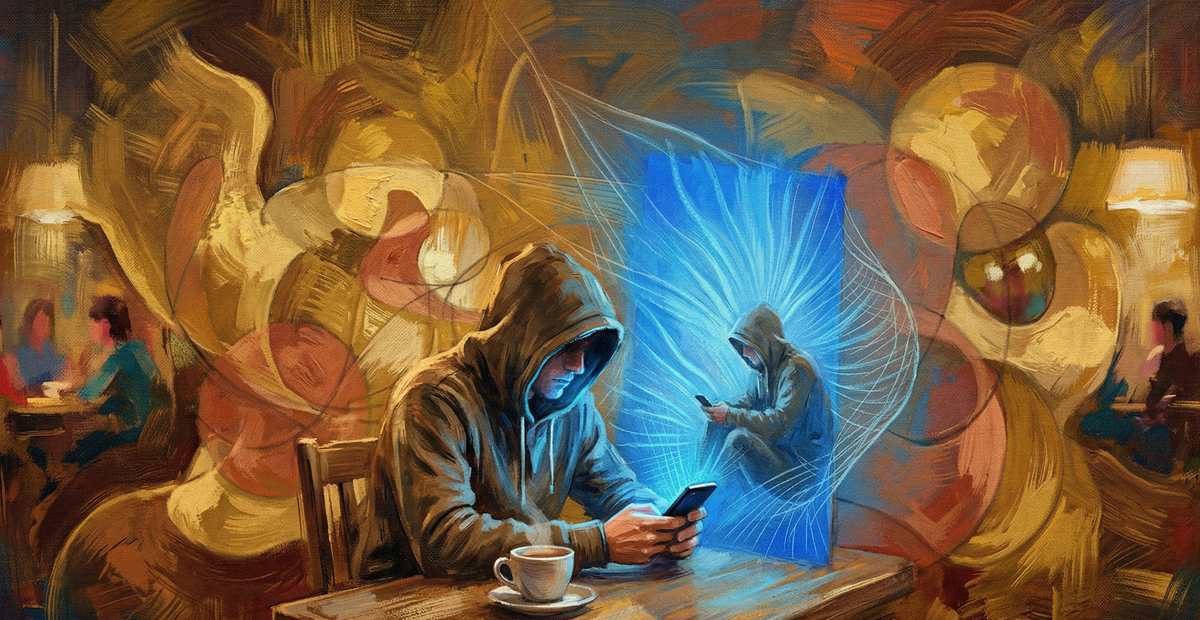
A child sits in a restaurant. Three, maybe four years old. A smartphone lies on the table. The child doesn’t look up, doesn’t ask anything, doesn’t whine. It is quiet. Anyone who is getting through life at their own limit can feel the relief of the adults around the table almost physically.
What is happening here may look like a modern, convenient solution, but at its core it is conditioning. In this moment, a nervous system is pragmatically learning how calming down works: not through relationship, or by bearing restlessness until it subsides on its own, but through high-frequency distraction from outside. The device takes over something that ought to grow slowly – the ability to regulate oneself.
I see this shift up close: my brother Dominik is twenty now, the first in our family to grow up as a true digital native. I myself, born in 1996, still knew physical limits. My phone came late, and I was only allowed to play on the computer for limited stretches. When I played Stronghold, an egg timer ticked relentlessly in the background. Of course I hated it, but looking back, it was probably a massive protective factor.
Instead, I read. I started at the age of four, and it dug itself deep into my inner architecture: the ability to trust a text, to follow a story for hours, to immerse myself in it and, now and then, to bear silence.
For my brother – as for many of his generation – the world was already a different one. A PlayStation very early, more television, the smartphone always within reach. For many, reaching for the phone after waking up has long stopped being a conscious decision; it is a reflex that comes before actually being awake. The device runs during meals, alongside conversations, on the way somewhere, during breaks, even in moments that could simply be empty. Often you sit at the computer and watch YouTube at the same time. Parallel streams of stimuli. None goes deep, none satisfies.
I know the pattern. In difficult phases of my life, I often filled emptiness with substances. The dopamine system is surprisingly indifferent to how. Whether a bottle of wine, a line of coke or an endless multiplayer loop – the mechanics remain similar: creating distance from the problem, generating arousal, dimming inner restlessness, filling the inner hole.
When this cycle runs at full throttle for a long time, the brain adapts. It protects itself. As a society, we misjudge the consequence completely: a young person lies on the bed, does nothing, wants nothing, seems neither depressed nor angry, just empty. Even the phone barely excites them anymore. This tips into states that clinically resemble anhedonia – the inability to really feel pleasure anymore. What looks like teenage laziness is then a physiological freeze: a nervous system in protective mode after running non-stop.
It eats its way into everyday life. We see a lack of capacity to cope that sets in before any real stress has even begun. It becomes especially visible in reliability. Agreements, appointments, commitments – the social foundation is becoming porous. In Dominik’s circle and among countless members of this generation, I see this deep “Alles wurscht” feeling, as we say in Vienna: nothing matters. That empty, uninvolved gaze, a mental drifting off while everything keeps running. People ghost, cancel at the last minute or simply don’t show up. Not out of malice. For an overstimulated, “anhedonic” brain, the weight of a promise simply drowns in the background noise. If an action is not rewarded immediately, it loses relevance. The willingness to endure friction, which every real relationship needs, erodes.
Then there is the myth of digital nativity. We believe that anyone who swipes intuitively across glass understands the tool. Reality is shockingly often the opposite. Even the most basic detailed knowledge is crumbling. We are witnessing a fundamental estrangement from text. Reading comprehension is plummeting. And that is fatal, because books, specialist articles and serious newspapers are where depth, primary sources and reliable information live.
The architecture of information has shifted completely. Today, knowledge about the world is consumed primarily via TikTok or YouTube, carried by creators whose survival depends on the algorithm. Anyone who is drilled for views invests in sensational thumbnails and the hook of the first three seconds – rather than in careful research.
This amounts to a form of cognitive self-disempowerment. People voluntarily fall back on secondary sources alone and hope that some influencer has summarized the matter correctly. The impulse to go to the source and work through an unwieldy text oneself withers. People let others do their thinking. The world shrinks to black and white, because the cognitive patience for everything in between is simply missing.
This is exactly the blind spot where the next technological wave hits. Anyone who never really learned how to research loses their filter for reality. A cognitively disarmed generation is now meeting AI and deepfakes. If even a simple article is hardly checked for truth anymore – how is this neural architecture ever supposed to unmask synthetic illusions of reality, emotionally tailored to perfection? Without the habit of questioning sources, one is almost defenseless against disinformation. Knowledge collapses not only in quality but also in durability. It is chased in bite-sized pieces through an overstimulated system and evaporates straight out of short-term memory.
Whoever eradicates boredom completely kills the very state in which the inner life first begins to work. If we glue every free second shut with outside stimuli, we unlearn the encounter with ourselves. A spiritual bankruptcy disguised as constant availability. Whoever never learned to sit alone with themselves in a room seeks a hold in belonging at any price. The hunger for meaning goes blind – and becomes extremely easy to exploit.
We cannot yet even guess at the exponential long-term consequences. What happens in twenty years, when a generation moves into decisive political positions whose basic architecture is calibrated to permanent sensory overload, dwindling reliability and drastically lowered frustration tolerance?
Authoritarianism does not march into a wakeful society. It needs prepared ground.
Democracy is hard psychological labor. It demands compromise and the endurance of painful shades of gray. For a chronically exhausted nervous system, for which even a coffee date creates too much friction, this is simply no longer manageable. Authoritarian offers lure with the promise of relief. Hard lines instead of debate. Enemy images instead of complexity. To a person in a freeze state, that feels like salvation. Like calm. Exactly the same principle that keeps the child in the restaurant still.
We like to outsource the responsibility to the private sphere, as if this were merely a parenting problem. In truth, though, we are talking about the business model of tech corporations that ruthlessly turn our biology against us. A society that is collectively in a state of permanent arousal, wide open to every stimulus, is extremely easy to destabilize. For hostile states and anti-democratic movements, that is not a side effect but a strategic advantage.
Radicalism and authoritarianism no longer need marching columns. They need societies that have unlearned how to read primary sources, how to live by their commitments and how to endure restlessness in their own bodies. People so exhausted that they long for nothing more than a numbness that finally works.
Back then, an egg timer still ticked while I played. Today there is no sound left that tells us when it is over.
Originally published in German as “Konditioniert. Wie der Alltag den politischen Menschen formt.” English version by Dorian Rammer, translated with AI assistance.