When Meaning Becomes a Weapon
An essay on Janne Teller’s Nothing, The Sinner and the temptation to hide fear behind philosophy. On false searches for meaning, group dynamics and what remains when meaning becomes a ritual – and we learn to live it instead of proving it.
On false philosophy and the fear we call meaning
What happens when meaning is no longer sought but forced? This essay brings together Janne Teller’s Nothing and the series The Sinner – and asks why the search for meaning sometimes becomes a cult, and what really holds us.
I.
Imagine a school class deciding to prove the meaning of life. They collect objects – things that matter to them. A fishing rod. A pair of shoes. Books. At first it sounds harmless, almost touching. Children who want to give a former classmate proof that life has meaning – not least to cheer themselves up, too.
But then it tips over. The next sacrifice has to be bigger. More meaningful. No one suspects what is beginning to develop at enormous speed – and what young people acting in good faith can be capable of.
That is the premise of Janne Teller’s “Nothing” (in Danish, “Intet”). The controversial novel, which sparked fierce debate in Denmark and was even banned at a number of schools, is a masterpiece. Its main theme – the search for direction in life – is seen from an interesting angle: the narrator is a 13-year-old girl named Agnes, who, together with her classmates, believes she has lost the meaning in pretty much everything.
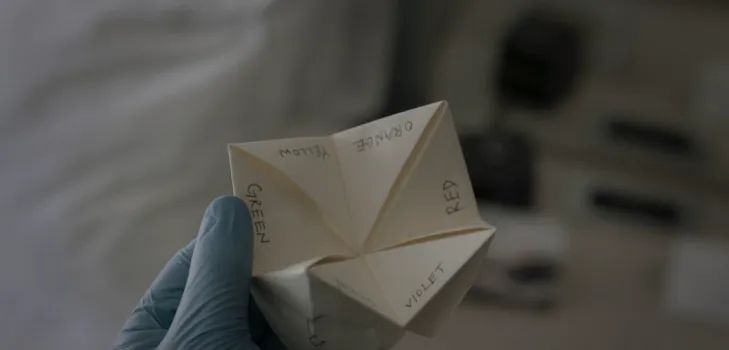
Now a change of scene. An American series, “The Sinner,” season three. Two college friends, Jamie and Nick, used to play a game. They folded a paper fortune teller – “Himmel und Hölle,” heaven and hell, as I know it from my childhood; in English it is often called a cootie catcher. But for them this oracle decided over life and death: Do we jump off the bridge? Do we bury ourselves alive?
The logic behind it: “If there is no God, life is pure chance. So let chance decide what happens.” Philosophy as Russian roulette.
Two completely different stories. A Danish young adult novel. An American crime series. And yet the same pattern: meaning is performed instead of lived. The class sacrifices to prove that something matters. Jamie and Nick stage extreme experiences in order to feel something. Both fail.
My thesis: Teller’s novel and “The Sinner” do not show the triumph of nihilism, but the failure of bad meaning-making. Where meaning becomes a weapon, where it is to be forced through sacrifice or violence, cults and destruction follow. Meaning that holds comes from somewhere else: from relationships, from responsibility, from lived practice.
II.
Both stories begin with a prophet. Or rather: with someone who thinks he is one.
In “Nothing” he is called Pierre Anthon. He is 13 years old, and one morning he stands up in the classroom, announces “Nothing matters. I have known that for a long time. So nothing is worth doing” – and leaves. He walks out of school, climbs into a plum tree and stays there. From up there he throws plums at his classmates and shouts: “In a few years you’ll all be dead and forgotten!”
Pierre Anthon is not a philosopher. He is an adolescent boy who has just discovered Camus and thinks he has seen through the universe. His insight is not wrong – life is finite. But his conclusion is: “So nothing is worth doing.” As if finiteness ruled out meaning.
In “The Sinner,” the prophet is called Nick Haas. He is charismatic, a failure, and he initiated his college friend Jamie into Nietzsche. “God is dead,” Nietzsche wrote – and Nick translated it like this: “So there is no morality. So we have to become the Übermensch, who creates his own morality and conquers fear.” Nick and Jamie called themselves “Übermenschen.” They jumped off bridges. They had each other buried alive. They drove knives through their hands – in public, as a statement.
Both of them, Pierre Anthon as much as Nick Haas, are what today would be called “edgelords.” People who wear philosophy as a mask of coolness. Who provoke for the sake of provoking. Who do not understand nihilism as a problem but as an identity. And who drag others in with them.
A short digression on Nietzsche (because I find him fascinating, as a person and as a philosopher):
Friedrich Nietzsche never wrote: “God is dead, so do whatever you want.” Quite the opposite. When he wrote the famous sentence in “The Gay Science” – “God is dead! God remains dead! And we have killed him!” – it was no cheer of triumph. It was a warning of a coming crisis of morality: a world in which people no longer have any moral anchors. And he knew how dangerous that is.
Nietzsche himself lived in permanent crisis. Chronic pain, loneliness, later madness. He knew suffering. And he knew how tempting it is to fall into nothingness when the old values break apart. That is why he wrote about the “Übermensch” – not as a justification for violence, but as an answer to the crisis.
His “Übermensch” was meant to create new values – through discipline, creative power, responsibility. Not through domination. Nietzsche meant self-overcoming, not rule over others. “He who has a why to live for can bear almost any how” – that is how his line from “Twilight of the Idols” is usually quoted. That is the opposite of what Pierre Anthon and Nick make of him. They read Nietzsche as a justification for nihilism. But Nietzsche was not a nihilist. He was an anti-nihilist.
But that is not on the pages a college student picks out. Pierre Anthon and Nick Haas read philosophy selectively. They took the “cool” parts and left out the responsibility. That is philosophical cherry-picking. And it ends in violence.
III.
The real horror lies in what happens when no one steps in.
In “Nothing,” the adults hear what Pierre Anthon is saying. The teachers know. The parents know. But no one does anything. People hope it will sort itself out.
So the class decides: We will prove to him that something has meaning.
They build a “heap of meaning.” At first it is small things. But then it becomes clear that if I sacrifice something that doesn’t really matter to me, it doesn’t count. So the next sacrifice has to be harder. The class begins to decide for one another what must be sacrificed.
No one says no. Because no one wants to look like a weakling. Because the group wants it.
And Agnes, the narrator? She goes along with it. She watches. She becomes complicit – not through action, but through passivity. That may be the most frightening part: they all know it is wrong. But no one has the courage to draw the line. Everyone waits for someone else to step in. Everyone believes it cannot get that bad.
And while everyone waits, it gets worse.
That is the mechanism: escalation through the group. Someone sets a limit. The group shifts it. The next limit is crossed. And at some point there are no limits left.
In “The Sinner,” it plays out in a similar way, only between two people. Jamie had broken free of Nick’s influence. He had grown up, married, become a teacher, and was expecting a child. But then Nick stood at his door, and Jamie let him back in. Why? Because he was afraid. Afraid of responsibility. Afraid of meaninglessness.
Nick comes back. And with him come the old rituals. The paper oracle. The dares. The philosophical conversations. But Nick is not a philosopher – he is a manipulator. Almost a cult leader. And Jamie, in good faith, lets himself be drawn in. He believes it is about truth. In fact it is only about Nick’s power.
There is a cult film, “Fight Club,” that shows a similar pattern. Men who are bored. Who experience their lives as meaningless. Who look for direction through violence. “How much can you know about yourself if you’ve never been in a fight?” asks Tyler Durden. And Jamie and Nick ask: “How much can you know about yourself if you’ve never looked death in the face?”
The answer is: nothing at all. Because pain proves nothing.
IV.
In the end the mask falls. And somewhere in between lies the point at which meaning tips over: from the need for direction to the fear of meaninglessness. From searching to forcing. From the question to the cult.
Jamie dies – and breaks down. For months he philosophized about “God is dead.” But when it really comes to that, he cries. He begs. He screams. All the Nietzsche energy is gone. What remains is a frightened man who does not want to die.
That is the truth: it was never about philosophy. It was about fear. Fear of meaninglessness. Fear that you yourself are nothing. And instead of bearing this fear, instead of naming it, they hid it – behind intellectual games, behind rituals, behind violence.
Jamie did not want to defeat death. He wanted to feel that he exists. But when he actually looks death in the face, he realizes that he wants to live. All along it was fear.
In “Nothing,” the heap is finished. The class has sacrificed everything. They bring it to an old sawmill. And then something absurd happens: the heap is discovered as a work of art. A New York museum wants to buy it. For millions.
But as soon as the heap turns into money – as soon as it is commercialized, monetized – it loses all real meaning.
Pierre Anthon shouts: “If this pile of garbage ever meant anything, it stopped meaning anything when you sold it for money.”
The paradox: the class wanted to prove that something matters. But meaning cannot be proven. It does not come from sacrifice. Not from violence. Not from display. It comes from doing, from everyday life, from the small gestures no one sees.
Pierre Anthon was partly right: meaning cannot be forced. But he was also wrong: meaning exists anyway. Just not in the way he – or the class – looked for it.
V.
So what really holds us?
Not the heap. Not the paper oracle. Not staged philosophy. What holds is what remains when the pain eases.
In “The Sinner” there is a minor character: Sonya, an artist. What she says, in essence, goes to the heart of it: men want intimacy just like everyone else, they long for it, but they are taught that vulnerability is weakness – and that is culturally traumatic.
Jamie and Nick – and Pierre Anthon too – are afraid of vulnerability. Of admitting that they do not know what the purpose of life is. Of admitting that they need help. So they play at strength. They play at philosophy so they don’t have to feel. And in doing so, they break.
Meaning does not come from sacrifice. Meaning comes from relationships. From the hand you hold. From the responsibility you take on – not because it proves something, but because it is right.
Resilience is not: I endure the pain, so I am strong.
Resilience is: I can bear the pain because I am not alone. Because there are people who catch me. Because there are reasons to keep going, even if none of them has any cosmic meaning.
VI.
Perhaps we need stories like these. Not to feel good, but to see where the hunger for meaning can lead when it takes on a life of its own. To understand how quickly group dynamics tip. How dangerous it is to leave young people alone with existential questions.
At first, Teller’s book was banned from schools in Denmark. Too brutal, said parents and teachers. Then it won awards. Later it became standard reading in schools. Translated into around 30 languages.
That alone says something: what disturbs us at first later becomes indispensable. Because it is true. Because it shows how morality erodes when no one steps in.
Season 3 of “The Sinner” split its audience. Some found the series brilliant. Others said: “Too philosophical.” But those who let themselves in for it said: “It wouldn’t let me go. It haunted me.”
Good art does not have to comfort. It only has to be true. And sometimes truth is harder than protection.
“What is the meaning of life?” is not a question you can push away. It comes. In adolescence. After losses. In crises. And if we then have no honest answers – none that allow for doubt – people look for their own. And sometimes those answers are dangerous.
Pierre Anthon, Jamie, Nick – they are symptoms. They are people who were left alone with existential questions. No one told them: “It’s okay that you feel this. And there are ways through it.”
What if life really is finite, sometimes cruel, often random? What then?
Then the answer is not: “So nothing is worth it.” The answer is: “That is exactly why it is worth it.” Because meaning does not exist in spite of finiteness, but because of it. Because we have only this one life. Because every gesture counts, precisely because it is fleeting.
VII.
In my own life I have often wrestled with crises of meaning. With the question: Why keep going if everything ends at some point?
The answer I found is not a philosophical one. It is practical: because there are people to whom I mean something. Because there are things I can do that help others. Because meaning does not arise in the head but in the world. In acting. In being there.
No heap. No oracle. No performance.
Just: Get up. Keep going. Hold the hand that holds mine.
That is not heroic. That is not philosophical. But it is enough.
Pierre Anthon was wrong. Jamie and Nick were wrong. Not because life objectively has meaning. But because they thought meaning had to be proven. Or forced. Or staged.
But meaning is not a heap. Meaning is not a game. Meaning is what happens when we stop searching for it – and start living it.
Originally published in German as “Wenn Sinn zur Waffe wird”. English version by Dorian Rammer, translated with AI assistance.
Even a small donation helps me set aside time for writing. Thank you.
Warm regards
Dorian Rammer