
Oscar Wilde and the Meaning of a Word That Outlived Him
Oscar Wilde was convicted for his “gaiety” – before “gay” meant what he was punished for. An essay on language, beauty and the man whose trial helped shape modern homophobia.
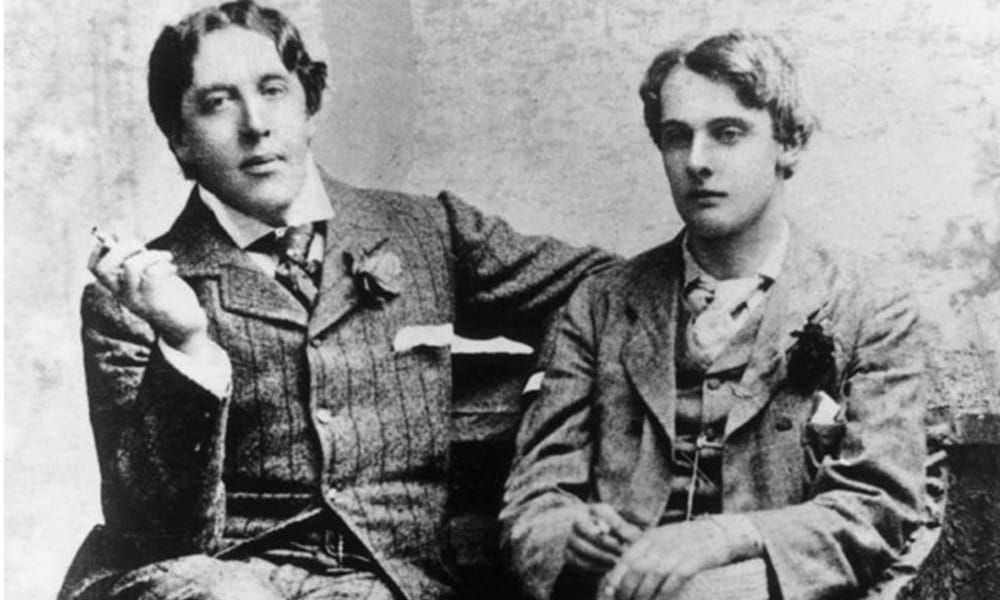
Gay & gay – one word, two meanings, one fate.
I. A Discovery
I own The Picture of Dorian Gray in several editions. When a book bears your first name, and you know that your name really was taken from it, you develop a certain passion for collecting. The English-language Collins Classics edition stands on my shelf, between a simple German translation and an old deluxe edition. Recently I opened it again – not to read it, but to browse the introduction.
There, in a side remark on the novel’s origins, one sentence caught my eye. The editors explained that the term gay originally came from gaiety – the joie de vivre and elegance with which gentlemen like Oscar Wilde presented themselves in their day. They had been too gay: too cheerful, too dapper, too conspicuous. And it was precisely this gaiety that later became the basis for the modern meaning of gay in the sense of “homosexual.”
I had to read it twice. The irony is perfect: Oscar Wilde was punished for his gaiety – even before gay officially meant what he was convicted for. He stood at the tipping point, at the moment when the word changed its meaning. You could say he was the first prominent victim of anti-gay discrimination before the term even existed.
II. The Dandy from Dublin
Oscar Wilde was born in Dublin in 1854. His mother, a poet and salon hostess, shaped him intellectually. He studied classics at Oxford, won literary prizes and moved to London – not to build a career, but to become a work of art himself.
And he succeeded. Within two years, Wilde was London’s most famous dandy: velvet suits, a lily in his buttonhole, wit as a weapon. He conquered society through style before he had published a single important work.
In 1884 he married Constance Lloyd, had two sons, wrote fairy tales and essays, and worked as an editor. Then, in 1890, his only novel appeared, first in a magazine and a year later as a book: The Picture of Dorian Gray. A scandal. Critics called it “immoral,” and its homoerotic undertones were impossible to miss.
But Wilde’s real genius showed itself on the stage. From 1892 on, he conquered London’s theaters with society comedies that were brilliant – sharp-tongued, witty, subversive. In February 1895, two of his plays were running at the same time in London’s West End. He was at the height of his fame. But in the year Dorian Gray came out as a book, the encounter began that would change his life.
III. The Golden Boy
In the summer of 1891, Wilde was introduced to a young man: Lord Alfred Douglas. Twenty years old, aristocratic, golden-haired, handsome, of a somewhat feminine nature. A poet. And obsessed with Wilde’s novel – he claimed to have read Dorian Gray fourteen times.
His mother called him “Bosie” – a pet form of “boysie,” derived from “boy.” He was her favorite child. The nickname stayed with him all his life.
They became friends, and a year later lovers. Douglas was sixteen years younger than Wilde, impulsive, spoiled, with a ferocious temper. Their relationship was intense and destructive at the same time. Wilde wrote him letters of overwhelming poetry: “It is a marvel that those red rose-leaf lips of yours should be made no less for the madness of music and song than for the madness of kissing.”
But Douglas also brought his father with him.
IV. The Word and Its History
To understand what followed, we need to know what gay meant back then.
The word comes from the Old French gai – “cheerful,” “carefree” – and gaiety derives from it, not the other way around. In Victorian England, however, the word took on a double meaning. Gay women were prostitutes. Gay life meant debauchery. The word shifted from “fun-loving” to “dissolute.”
Gaiety described something between elegance and moral transgression. Anyone full of gaiety was considered charming and cultivated – but also frivolous, eccentric, “too fond of pleasure.” In London’s upper class, gaiety could be a coded hint of sexual nonconformity.
Such shifts in meaning were not a purely English phenomenon. In German, the word “schwul” went through a similar path. Originally a variant of “schwül” – sultry, oppressive, glowing – it was later used as a derogatory term for homosexuality; today it is used neutrally or with pride. Here, too, a word changed from describing a state to naming an identity.
Oscar Wilde and the Aesthetes were the embodiment of this gaiety: artistic, elegant, sensual – and latently dangerous. They were gay gentlemen before the word took on its sexual meaning. Only from the 1920s on did gay men begin to call themselves gay – first as a code word, later as an open label. With the Gay Liberation movement of the 1960s and 70s, gay became a political identity.
But Oscar Wilde lived in the in-between. The meaning of the word changed through him.
V. The Card
John Sholto Douglas, 9th Marquess of Queensberry, was Douglas’s father, and he hated Wilde. He hounded the two through London, threatened restaurant owners and turned up at Wilde’s house with a professional boxer.
On February 18, 1895 – four days after the premiere of The Importance of Being Earnest – Queensberry left a calling card at Wilde’s club: “For Oscar Wilde: Posing Somdomite” (a misspelling of “sodomite”).
Wilde could have fled. Friends advised him to, but Douglas urged him to sue his father. Wilde agreed. It was the most consequential decision of his life.
VI. The Trial
The libel trial against Queensberry began on April 3, 1895. Wilde performed brilliantly, quick-witted and self-assured. But Queensberry’s lawyer, Edward Carson, announced witnesses: young men with whom Wilde had had sexual contact.
In 1885, Victorian England had made every sexual act between men punishable as gross indecency. Up to two years in prison. On April 5, Wilde withdrew his suit. A warrant for his arrest was issued that same day. Overnight his name disappeared from posters and programs, and within weeks his plays were taken off.
Two criminal trials followed. The first ended with a hung jury. The second, on May 25, 1895, with a guilty verdict. The judge pronounced the sentence with open disgust: two years in prison with hard labor, “the severest sentence that the law allows.” And he added: “In my judgment it is totally inadequate for such a case as this.”
In the courtroom, some people cried “Shame!” – whether at him or at the sentence remains unclear to this day.
VII. Exile and Death
Wilde spent two years in prison. Hard labor, humiliation, even months of solitary confinement. This time destroyed him physically and mentally. He was not allowed to write, could hardly read and was not allowed to speak to anyone. Only in the last phase did he receive writing materials again – and De Profundis was written, a letter of some 50,000 words to Lord Alfred Douglas.
After his release in 1897, Wilde was an outcast in England.
No one wanted to see him. His wife Constance had taken the children to Switzerland and changed their surname to Holland to protect them.
Wilde left the country and went to France – a country that was prudish too, but less repressive in its laws. From then on he lived under the pseudonym Sebastian Melmoth (an allusion to the Gothic novel Melmoth the Wanderer, about a damned seeker).
He and Douglas met once more and lived together briefly in Naples. In October 1897 they made a trip to the island of Capri and stayed at the elegant Hotel Quisisana – but the hotel manager recognized Wilde despite his pseudonym. They were thrown out and even refused breakfast. The Swedish doctor Axel Munthe, who lived on Capri, apologized for their treatment and invited the two to his Villa San Michele. They stayed there for a few days.
But this episode also showed that even in exile, Wilde was not safe. Contempt followed him everywhere. Shortly afterward, Douglas and Wilde separated for good. The love was used up. Still in Naples, Wilde had written that Douglas had ruined his life, so he could not help loving him.
He lived in cheap hotels, destitute, shunned by most of his former friends. An untreated ear infection from his time in prison developed into meningitis. On November 30, 1900, at the dawn of the new century, Oscar Wilde died in Paris. He was 46 years old. One of his last remarks is said to have been: “If another century began and I was still alive, it would really be more than the English could bear.”
VIII. The Legacy
Oscar Wilde died in exile, impoverished, ostracized. But what Victorian England wanted to kill in him survived – his works, his wit, his refusal to apologize. And why should he have?
In the 1950s and 60s, early LGBT activists rediscovered Wilde. His life became a parable: the man who was punished for beauty and love in a world that feared both.
Today Oscar Wilde is regarded as one of the first prominent martyrs of modern homophobia. His 1895 trial marks the moment when homosexuality was no longer seen only as a “sin” but was criminalized as an identity. He was one of the first and best-known victims of that alliance of medicine, morality and law that persecuted queer people well into the 20th century – and in some corners of the world still does today.
And the word gay? To this day it carries something of the gaiety that Wilde was once accused of: the right to live joy, style and sensuality openly. Perhaps the editors of the Collins edition did not even know how much truth lay in that side remark.
IX. He Was Gay – in Both Senses
When I show my face on Instagram today, my name, my queerness, I do it partly because Wilde was not allowed to. Because he was punished for exactly what should be a matter of course today: being visible without having to apologize for it.
Oscar Wilde was gay – cheerful, elegant, aesthetic, full of gaiety. And homosexual. He embodied the joie de vivre that Victorian society admired and feared, and he was destroyed for it before there was even a name for what he was. He was punished for beauty, for style, for love.
His life was a work of art. His death an indictment. And his name – whether Oscar or Dorian Gray – reminds us that some people are ahead of their time. That what is taken for granted today once meant prison. And that we owe the freedom we have today to people like him.
Wilde once wrote: “We are all in the gutter, but some of us are looking at the stars.” He looked at the stars. And today we do it with him.
Originally published in German as “Oscar Wilde und die Bedeutung eines Wortes, das ihn überlebte”. English version by Dorian Rammer, translated with AI assistance.