No Heaven Over Delphi: Between Truth, Measure and Courage
Among the stones of Delphi lies more than history: a reminder of measure, of courage and of the imposition of knowing yourself. No heaven, only light – and that is enough.
Delphi was once the center of the world. What remains of it today is an idea: that truth is not proclaimed but sought – again and again, by each of us anew.
I know this place only from texts, from history books and stories.
And so this is how I imagine it: light on stone, wind in the dust, a landscape that knows more than it says:
Warm dust lies between the rows of columns. The sun burns down on stones that have seen more than I will ever know. No heaven in the religious sense, only sky as an expanse that promises nothing. I step into the shade and read the grooves in the marble with my fingers, as if a language could be felt. The way up was rocky, my breath short. Up here a wind blows that tastes of thyme and heat.
At the threshold of the Temple of Apollo stood the famous inscription: Know thyself. Not a call to self-optimization, more of an imposition. Perhaps that is antiquity’s real answer: the calm that arises when no one pretends to know everything anymore.
I am not here for a prophecy. I wanted to understand why the old things move me. Why this place, where thousands asked and seldom found answers, still touches something in us today. My steps echo between the stones. That is enough to make me feel less lost.
What the Oracle Leaves Unsaid
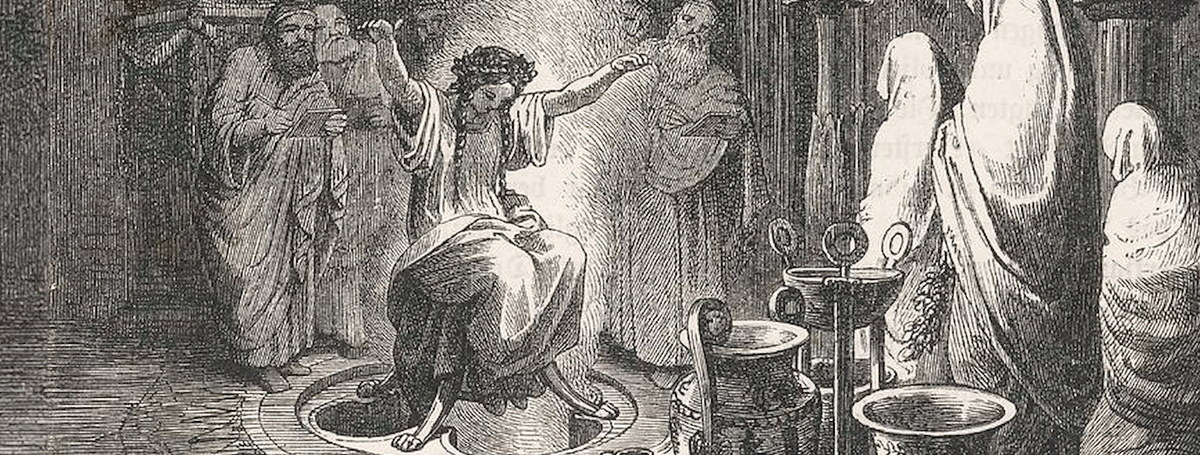
The oracle of Delphi was famous for its obscurity. The Pythia, priestess of Apollo, sat on a tripod above a cleft in the earth and murmured sentences ambiguous enough to be read either way. Croesus, the richest king of his time, asked whether he should march against the Persians. The answer: If you cross the river, you will destroy a great empire. He marched – and destroyed his own.
The oracle never gave certainty. It gave mirrors. It confronted those who asked with themselves, with their hubris, their fear, their longing for certainty. Oedipus wanted to escape his fate – and for that very reason ran straight into it. To ask is to take a risk. Whoever came to Delphi was looking not for comfort but for consequence.
No heaven over Delphi means: no divine authority to relieve you. No transcendence to take responsibility off your shoulders. Only you, your questions and the silence afterward. Antiquity knew that insight does not set you free – it obliges you. Whoever knows themselves can no longer pretend not to know.
Sometimes that is the real provocation: the oracle offered no redemption. It offered truth – and truth is rarely comfortable.
The Greeks understood that a person is not separate from their decisions. Whoever came to Delphi came not as a tourist but as a seeker. And what they found was not an answer but an attitude: the willingness to live with uncertainty.
Icarus, or: Flying Without a Net
The myth tells of a father and a son. Daedalus, the brilliant craftsman, builds wings from feathers, thread and wax. He warns his son Icarus: Not too high, not too low. The sun melts the wax, the sea drags you down. Keep the measure.
Icarus nods. And flies higher anyway.
There are different readings of this story. One says: hubris is punished. The other: human beings must go beyond themselves, or they remain trapped. I lean toward the second. Icarus did not fail because he flew. He failed because no heaven caught him. Because the world gives no guarantees. Wings of wax remain wings of wax.
This is not a warning against flying. It is a reminder that we are mortal. That we can fail. That the flight is real – and so is the fall.
Antiquity did not moralize about it. It simply held up a mirror to us: Look, this is what you are. Tender, defiant, vulnerable. And sometimes wiser only after the pain.
Today we build other wings. We call them algorithms, tracking apps, optimization programs. We measure sleep, steps, calories, mood. We believe that if we only have enough data, plan enough, control enough, we will manage the flight without the fall. Then we will be safe.
But safety is an illusion. The digital oracles promise us predictability – and deliver probabilities. They give us a feeling of control while overwhelming us at the same time. Today they answer in charts, rankings, forecasts. We call it knowledge – and yet we seldom feel safer.
Perhaps because between number and meaning there remains a gap that stories used to fill. Not to simplify the world – but to make it bearable.
We have digitized Delphi. Today the oracle answers us in trends and metrics. Only we no longer know what we asked. And no algorithm is a heaven. No dashboard catches us when we fall.
Icarus knew that. He flew anyway. Not out of stupidity, but out of courage. Human beings want to go beyond themselves. That is not hubris, that is being human. The only question is: Do we still know that our wings are made of wax?
Self-Knowledge – The Imposition of Not Knowing
“Know thyself” sounds like a command, but it is an invitation. Not to measure yourself, but to meet yourself. Sometimes that means having one answer fewer – and being more honest instead.
Modernity confuses self-knowledge with self-analysis. We want to understand ourselves like machines: input, output, optimization. We do therapy, we track, we test. As if a human being were a puzzle that can be solved.
But self-knowledge is not a project. It is a state. An awareness that we are more than the sum of our data. That we carry contradictions within us, shadows, fractures. And that this is all right.
I believe self-knowledge begins where I dare not to know. Not papering over, not speeding up, not breaking things into pieces. Bearing what is. The ancients did not call it therapy, but they knew the movement: from noise inward, from pose to poise.
There are sides of me I do not like to show. For such things antiquity had figures and gods, masks and stages. We have mirrors and feeds. The difference? Back then people knew that every role is only a part. Today we mistake the fragment for the whole.
Modernity gives us tools for measuring ourselves. But encounter needs no app. It needs time, stillness, sometimes courage too. The courage not to have to understand everything. The courage to live with ambiguity.
A small exercise: Once a day, allow yourself not to know something. Once a day, do not react. Once a day, ask whether what everyone is doing is really yours. That is not asceticism, that is hygiene. Skepticism as a daily practice against the great hubris.
No heaven over Delphi also means: no one saves you from yourself. But that is not a threat. It is a freedom.
Perhaps this is the other half of the same truth: self-knowledge inward, measure outward.
Measure – What Holds Us When Nothing Holds Us
Next to “Know thyself,” a second inscription stood at the Temple of Apollo: Nothing in excess. Two sentences like twins that protect each other. Together they form the ethical frame of being human.
Measure is not renunciation out of fear, but a choice out of dignity.
The Greeks understood balance not as a restriction but as a form of freedom. A life in measure is not a mediocre life. It is a tuned life. Like an instrument strung neither too tight nor too loose, but just right to sound.
We live in a world of extremes. Some burn out, others freeze inside. Between asceticism and excess lies the right measure – and it is not a lukewarm middle but a precise decision between two exaggerations.
What does measure look like on a Tuesday? A no that is not apologized for. A pause that is not filled. A meal that simply tastes good, without a photo. Nothing big. But that is exactly what makes it big.
Measure is not a rule, it is an attitude. It does not mean wanting nothing. It means knowing what is enough. The body used to know that. Today an app has to remind us to breathe.
Sometimes the right measure is not a question of knowing but of feeling. Antiquity built columns in proportions that calm the eye. It wrote verses in rhythms that guide the breath. It looked for balance everywhere – not to become sterile, but to sound.
When I lie awake at night and everything is too much, I sometimes think of these inscriptions. Know thyself – but keep the measure. Go beyond your limits – but do not forget that you are mortal. Ask – but expect no redemption.
That is not a contradiction. That is the art of living.
Enough Light
In the end, what remains is the view across the stones. No heaven opening up, no voice from the depths. Only light that draws edges, and wind that stirs old warmth.
Icarus has fallen. The oracle is silent. Daedalus built wings that did not hold. Oedipus asked, and fate answered. Everything is consequence, nothing is guarantee.
And still: it is enough.
No heaven over Delphi – but enough light to see the way. No divine rescue – but an attitude that holds. No oracle that explains everything – but an inscription that reminds us: Know thyself. Keep the measure. Go anyway.
Perhaps what fascinates us about antiquity is exactly this: it promises nothing. It does not console. It only holds up a mirror and says: You are human. With everything that comes with it. With the urge upward and the fall downward. With the longing for knowledge and the fear of truth.
We do not have to become divine to find meaning. It is enough to be human – and to keep the measure. Not out of weakness, but out of dignity. Not out of fear, but out of wisdom.
Antiquity teaches no solutions. It reminds us of attitudes. Of walking upright. Of a calm tone. Of the sense that we do not have to understand everything to live rightly.
No heaven over Delphi. Only dust and light. But perhaps that is enough – for a life in truth.
Originally published in German as “Kein Himmel über Delphi – Zwischen Wahrheit, Maß und Mut”. English version by Dorian Rammer, translated with AI assistance.