
I Don’t Understand You Yet
Propofol, a doctor who went along with it, and a body he could no longer trust: an essay on Michael Jackson, on addiction as an attempt to escape an unbearable state – and on what I know of it myself.
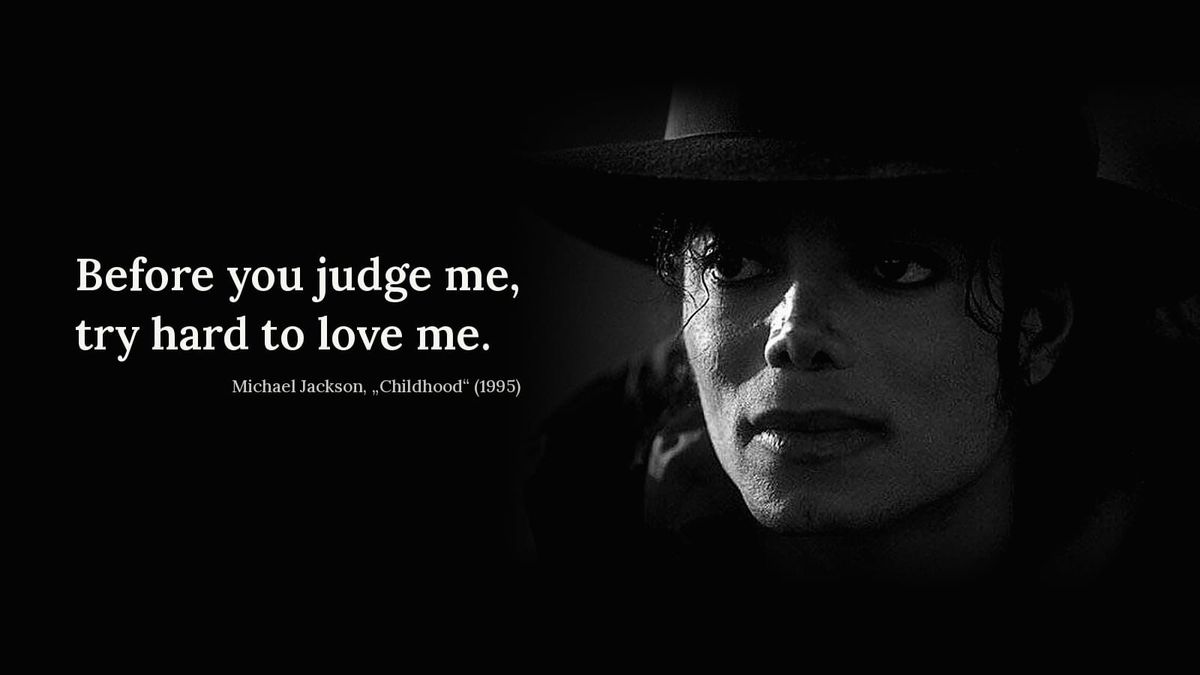
It is just after five in the morning. I have been sleeping badly for days, and I am sitting over a Reddit thread about Michael Jackson’s propofol use. Someone writes that for weeks he slept only six to eight hours a week and at some point seriously considered going to an emergency room to be sedated, just to finally get some rest. I read the sentence twice. Then I notice that I am nodding.
This is how I think about Michael Jackson these days. Rarely about the music first, more often about the mechanics behind it: about a nervous system that at some point can no longer be switched off, and about what people do against it.
Propofol is an anesthetic. It produces unconsciousness, and from everything sleep research knows about it, it does not replace the architecture of a night, with its deep sleep and REM phases; it covers it up. That makes the story more tragic. A person can feel that they are finally sleeping while their body gets something entirely different from what it needs.
It was not the first dependency of his life. In 1993 he publicly admitted that he had become dependent on painkillers, cut short his tour and went into treatment, helped among others by Elizabeth Taylor. Four years later he released a song called “Morphine,” in which he names Demerol so openly that no fan has to decode anything. You can read two things into this: that he was more honest with himself than people often give him credit for, and that this honesty still did not protect him from the next dependency.
Whether he wanted propofol is, for me, the less interesting question. Of course he wanted it, at times desperately. More interesting is who helped him, and how a desperate request turned into a nightly routine. An adult may wish for risky things. A doctor still carries a different responsibility from the patient who asks, and that is where I see the real failure: not in the wish, but in its institutionalization.
This institutionalization has a long history. Debbie Rowe, his second wife, knew him from the office of his dermatologist Arnold Klein, where she worked as an assistant. In 2013 she testified under oath that he had already received propofol during treatments in doctors’ offices, and that Klein and the plastic surgeon Steven Hoefflin had tried to outdo each other with medication: “These idiots were going back and forth the whole time, not caring about him.” In 1997, on the HIStory tour, sleeping pills no longer helped him between concerts. In Munich, according to Rowe, two German doctors twice set up medical equipment in his hotel suite and kept him under propofol for eight hours each time.
He was warned, though. The Munich doctors already pointed out the dangers, Rowe said, but “he was just more worried about not sleeping.” A year or two later he asked the anesthesiologist Christine Quinn for propofol to help him sleep. She refused; that, she said, was not real sleep. In 2009 the nurse Cherilyn Lee warned him that the drug was not safe at home. His doctors, he replied, considered it safe as long as someone was monitoring him.
So the warnings came mostly from those who said no. It was the others who gave it to him. I think that is the pattern: whoever wanted to stay in his inner circle was better off not setting him any limits. And a man who, according to Rowe, never questioned his doctors listened, in the end, to the yes-men.
How far it ultimately went is well documented. Conrad Murray, his personal physician during rehearsals for the concert series “This Is It,” was to receive $150,000 a month. By his own account, he gave Jackson propofol almost every night for weeks, in a bedroom in Los Angeles, without the monitoring that would be a matter of course in a hospital. In the early hours of June 25, 2009, more sedatives were added; by the afternoon Jackson was dead. In 2011 Murray was convicted of involuntary manslaughter. A doctor who exists for a single patient and is paid by that patient’s project falls into a dependency of his own. In that bedroom, two dependencies met.
I know this shift myself, just under a different name. A few years ago I repeatedly took six Temesta at once, a sedative widely prescribed in Austria, not because I enjoyed pills, but because at some point I could no longer bear my own state. When I later wanted to stop, withdrawal symptoms set in, and only then did I understand how far my nervous system had grown used to the substance. Among the drugs Jackson received on his last night was lorazepam, the active ingredient in Temesta.
A similarity opens up there, even a kind of kinship, and I ask myself: did I want to emulate him, or did it simply happen that way?
Addiction rarely begins with the wish to get high. Mostly it begins with the wish to get rid of a state you can no longer bear.
Important to know: Benzodiazepines such as lorazepam (sold as Temesta in Austria, as Ativan in the US) can cause dependence after just a few weeks of regular use. Anyone who has taken them for a longer time should not stop abruptly, because withdrawal can become dangerous, even causing seizures. Tapering belongs under medical supervision. Propofol is an anesthetic and, for good reason, is only used with constant monitoring of breathing and circulation. Help is available from your doctor and from addiction services. Austria: TelefonSeelsorge 142, around the clock. USA: SAMHSA National Helpline 1-800-662-4357 (free, 24/7); in a crisis, call or text 988. UK & Ireland: Samaritans 116 123. Other countries: findahelpline.com.
How hard he had to negotiate with his own body can be heard in a video another fan sent me: the mic feed from Munich, July 6, 1997, HIStory tour. Jackson had laryngitis that evening; you can clearly hear it in his voice, and still he sings along under the playback, strained in places, cracking in others. He was thirty-eight, in the middle of a tour of months of travel, rehearsals and a physically brutal show, and his sleep was already so wrecked that in this very city he slept under anesthesia.
You can see in this a man who could no longer really sing. I see a perfectionist who builds himself a system that catches mistakes and who, sick and exhausted, still tries to sound real. Playback not as fraud, but as one of many methods by which he forced his body to cooperate every night. Propofol was ultimately only the most radical of them: control over a body he could no longer trust, all the way into sleep.
He grew up in Gary, Indiana, in a small house with two bedrooms for eleven people, and was signed to Motown at ten. In his 1993 interview with Oprah Winfrey he told how, from the studio, he could see a park across the street where other children played baseball while he had to record inside, and how it made him cry every time. What he lacked was more than free time. It was the chance to be bad at something unobserved, without it immediately becoming a verdict on his worth. Add fear and violence at home, and a childhood becomes something that functions but does not hold everywhere.
A childhood like that rarely leaves behind an evenly matured person. More often a strange imbalance: extremely grown-up in some areas, disciplined and strategic, in the studio, on stage, in handling responsibility, and in others apparently stuck, roughly where normal development was interrupted. You can meet a fifty-year-old who leads a hundred people at work and emotionally struggles with something that should have been resolved at twelve. This has nothing to do with stupidity; it has more to do with a maturity that was not allowed to grow at the same pace everywhere.
I was a child myself who felt outside the norm, for other reasons and without a stage. For me at that age, Michael Jackson was more than a pop star I thought was cool. He was proof that you do not have to become like everyone else to be worth something. When he died in 2009, I was thirteen. In the weeks after, I cried for several nights, alone. I don’t think it was really about grief for a stranger. It was more that something had disappeared that had shown me how you can be different without being broken.
His mannequins fit the same pattern, even if at first you simply find them creepy. I find life-size dolls in the dark pretty eerie myself; for me, that is a very old, very irrational feeling. But with Jackson, the second question is worth asking: why does a grown man put such figures in his rooms and treat them like company?
A real person can reject you, leave you, use you, betray you. A mannequin can do none of that. It is human enough to simulate company and dead enough never to become dangerous. Closeness without risk, I almost wrote – but that is not quite it. It is more like company without the possibility of betrayal. A sad compromise for someone who probably learned very early that real closeness can be complicated and dangerous.
When it comes to his relationship with children, I don’t make it as easy for myself as most camps on the internet. What is established: allegations from 1993 ended in a civil settlement in 1994, without charges ever being filed. In 2005 he was acquitted on all counts in a criminal trial. In 2019 the documentary “Leaving Neverland” made known worldwide what Wade Robson and James Safechuck had already brought to court in 2013 and 2014. Their allegations remain highly contested to this day and have not been decided in court. Some defend everything because they love him. Others read every unusual closeness as proof of the worst. I can understand that someone finds in children something he himself lost early: play, directness, a world before status. And still, adults are responsible for boundaries that children cannot draw themselves, even where nothing criminal happens. Both can be true at the same time without one dissolving into the other. After almost twenty years I have no final answer, and by now I don’t trust anyone who pretends to have one.
What occupies me most about him these days is a sentence someone sent me in a screenshot: that he was at once hypervisible and deeply isolated. On a smaller scale, I think, this applies to anyone who learned early to make themselves visible through achievement and invisible through closeness. Millions knew his face. I doubt there were ten people in the world who really knew him.
Once again I have been thinking about what music should play at my own funeral. “Man in the Mirror” was settled immediately, no thought needed. For a long time it was only his songs. Recently Cass Elliot has joined them, with “Make Your Own Kind of Music,” a song about the right to make your own music, even if it leaves you alone. That, I think, is the real connection between Jackson and me, more than the tragedy or the addiction: the permission to keep your own voice, even if it does not fit the choir.
I don’t want to whitewash him, nor see him through rose-tinted glasses. Some of his decisions were dangerous, at least one of his doctors demonstrably failed, and some questions about his life will remain open for me. I am, I admit, a bit of a know-it-all, in the sense that when I claim something about Jackson, I want to be able to back it up. For years that has meant collecting interviews, court documents, home videos and medical testimony until a feeling becomes an argument. On Reddit this has gotten me into trouble, because I sometimes come in too sharply before supplying the sources. Both are true at once: I was usually right on the substance, and I could have started more kindly.
Recently I came across a comment of my own from years ago. I had written that you can hold someone responsible for their addiction and still have compassion for them. I think that applies to me too, and probably to most people I know.
With people we don’t immediately understand, perhaps we don’t have to judge immediately either. Sometimes the most honest sentence you can say about someone is: I don’t understand you yet.
PS: I interrupted writing this text twice to go to sleep myself. I am not quite sure whether that is irony or simply logical.
Originally published in German as “Ich verstehe dich noch nicht”. English version by Dorian Rammer, translated with AI assistance.
Even a small donation helps me set aside time for writing. Thank you.
Warm regards
Dorian Rammer