The Last Unicorn: On Molly Grue and the Loss of Innocence
A reflection on The Last Unicorn, and on Molly Grue, who reminds us of the loss of innocence. An essay on maturity, melancholy and quietly carrying on when hope grows fragile.
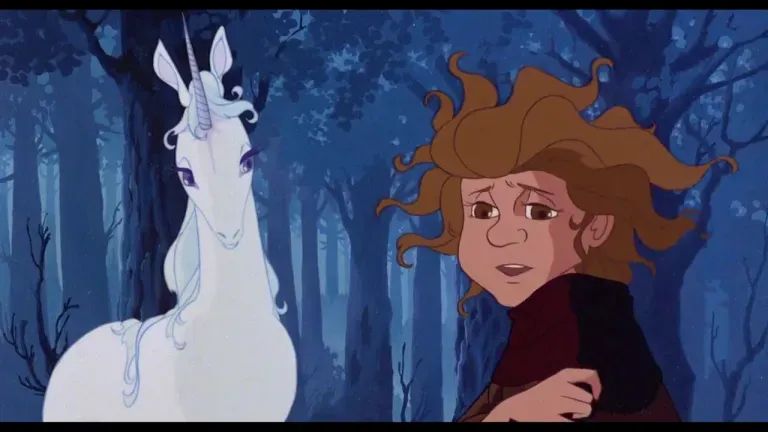
The Last Unicorn is a legendary animated film from 1982, based on the novel of the same name by Peter S. Beagle. In Germany and Austria it airs on television every year at Christmas – a ritual that, for many, belongs to childhood as much as Christmas cookies and candlelight.
It is a fairy tale for children that often touches adults more deeply than it did when they were young. The film version – voiced in the original by great actors such as Christopher Lee, Angela Lansbury, Jeff Bridges and Mia Farrow – often follows the book’s dialogue word for word, but condenses the plot to its emotional core.
Also worth mentioning: the moving songs were written by Jimmy Webb and performed by the band America, and the animation came from the Topcraft studio, whose core team later went on to form Studio Ghibli (Spirited Away, Howl’s Moving Castle).
A Story About Searching and Losing
The plot is quickly told: a unicorn, the last of her kind, sets out to find the others of her kind, who have vanished. A monster – the Red Bull of King Haggard – has driven them out of the world and into the sea, where they break against the shore as waves, unable to return to their true form.
Along the way, the unicorn teams up with the magician Schmendrick and with Molly Grue, who lives among a band of outlaws. For her protection, the unicorn is briefly turned into a human woman: Lady Amalthea, who lives at King Haggard’s court and slowly forgets who she really is.
In the end, the unicorn faces the Bull and brings the unicorns back into the world.
But for all its fairy-tale surface, The Last Unicorn is a film about loss. About aging. About sadness that cannot be driven away. And about a woman who came too late.
King Haggard and the Emptiness
King Haggard, the story’s antagonist, is not a classic fairy-tale figure. He is no greedy tyrant, no sadistic ruler. He is a deeply depressed old man who stopped hoping long ago. Nothing in the world brings him joy anymore, he says, and you believe every word.
The only exception: the unicorns he holds captive in the sea. Only when he looks at them does he still feel something – a remnant of what joy might once have been.
Haggard embodies what happens when you live too long without living. He hoards beauty because he can no longer feel any himself. He is a warning, and at the same time a figure you can understand, especially as an adult.
Perhaps Haggard also mirrors something we know well today: the attempt to preserve happiness by owning it, and forgetting to experience it along the way.
Despite its sometimes kitschy images, the film asks a lot of its young viewers. Looking back, The Last Unicorn did not leave only positive memories in me, surpassed only by even scarier classics of the time, such as The Dark Crystal.
It deals with death, loneliness and depression, and it is full of insights into adult life. Almost all the characters struggle with sadness: some openly, some in secret.
Molly Grue: The Real Heroine
One character, however, moves me in particular: Molly Grue, who lives with a band of outlaws and at first seems brash and tough, but turns out to be a deeply sensitive and empathetic person.
In the book you can explore her depth even better, but you can see it in the film too, if you look closely. The scene in which Molly meets the unicorn for the first time is one of the film’s strongest moments:
Molly: No, it can’t be. Can it be? Where have you been? Where have you been? Damn you! Where have you been?
Schmendrick: Don’t you talk to her that way!
Unicorn: I’m here now.
Molly: And where were you twenty years ago? Ten years ago? Where were you when I was new? When I was one of those innocent young maidens you always come to? How dare you! How dare you come to me now, when I am this!
[Weeps]
Schmendrick: Can you really see her? Do you know what she is?
Molly: If you had been waiting to see a unicorn, as long as I have…
Schmendrick: She’s the last unicorn in the world.
Molly: It would be the last unicorn that came to Molly Grue. It’s all right, I forgive you.
As a child, Molly’s words mean little to you. You understand that she is sad, but not why. As an adult who has already seen a lot, you get all the closer to the root of her despair.
Molly mourns the life she could have had. Perhaps not a specific missed chance, but the feeling that once seemed possible. She feels used up – by men, by circumstances, by life.
Her innocence is gone, and she cannot undo it. In fairy-tale tradition, unicorns come to virgin maidens, to pure, untouched young women. Molly is no longer one of them. She has grown old, grown hard, grown tired – and the unicorn comes anyway. But too late.
So all her pain and anger come together when she shouts at the unicorn: “How dare you come to me now, when I am this!” Not the woman she could have been.
Growing Up and Losing Faith
As a child, you still believe in many things. You see with your heart and have hope in life, without recognizing the hardness of what lies ahead.
But when time passes and one low after another hits, when you have to struggle, that pure view of life quickly fades, and you lose your faith. In unicorns. In justice. In the good.
Molly Grue embodies exactly this loss, and at the same time what comes after. She has stopped hoping, but not stopped acting. She has buried her dreams, but not her care for others. She is full of kindness, even though life has given her little of it back.
She drives her companions on in their quest and puts her own problems aside, however many she has. She motivates and encourages them, even though she herself is not without suffering.
That is true greatness: not preserving your innocence, but staying upright despite its loss.
Not believing that everything will be fine, but doing the right thing anyway.
Perhaps Molly is so moving because she embodies what many of us lack: the ability to stay good without staying unharmed.
Why Molly Is the Heroine
For me, Molly Grue is the real heroine of this story. Not because she saves the unicorns. The unicorn does that herself. But because she shows what strength really means: giving others courage when you barely have any left yourself.
Carrying on when you could have given up long ago. Forgiving – the unicorn, life, perhaps even yourself.
“It’s all right, I forgive you.”
This sentence, at the end of her accusation, is perhaps the most important in the whole film.
Molly forgives the unicorn without any apology, because she knows that bitterness would only wear her down further.
She lets go. Not because it would be fair. But because it is the only way to go on living.
What Stays
The Last Unicorn is a film that ages with you. As a child, you see the colorful pictures, the magic, the adventure.
As an adult, you see King Haggard, frozen in emptiness. You see Molly, who came too late.
You see the unicorn, who in the end is no longer the same as at the beginning – because she has loved, because she was human, because she knows loss.
Perhaps that is the real message of the film:
That innocence cannot be preserved. That life changes us, whether we want it to or not.
But that we still have a choice about who we want to be afterward.
Molly Grue made that choice.
And that is why, for me, she is the heroine.
Perhaps that is the real magic of this story: it shows us how even broken people can shine – not in spite of their cracks, but because of them.
Originally published in German as “Das letzte Einhorn – Über Molly Grue und den Verlust der Unschuld”. English version by Dorian Rammer, translated with AI assistance.
Even a small donation helps me set aside time for writing. Thank you.
Warm regards
Dorian Rammer