Spirituality of Resonance: Between Field and Figure
Puzzling answers from the world in music, glances, coincidences and decisions? Between the world soul (anima mundi), trauma and the longing for a hold, a spirituality emerges that takes psychology seriously without betraying meaning. No dogma – a field that holds, and questions that remain.
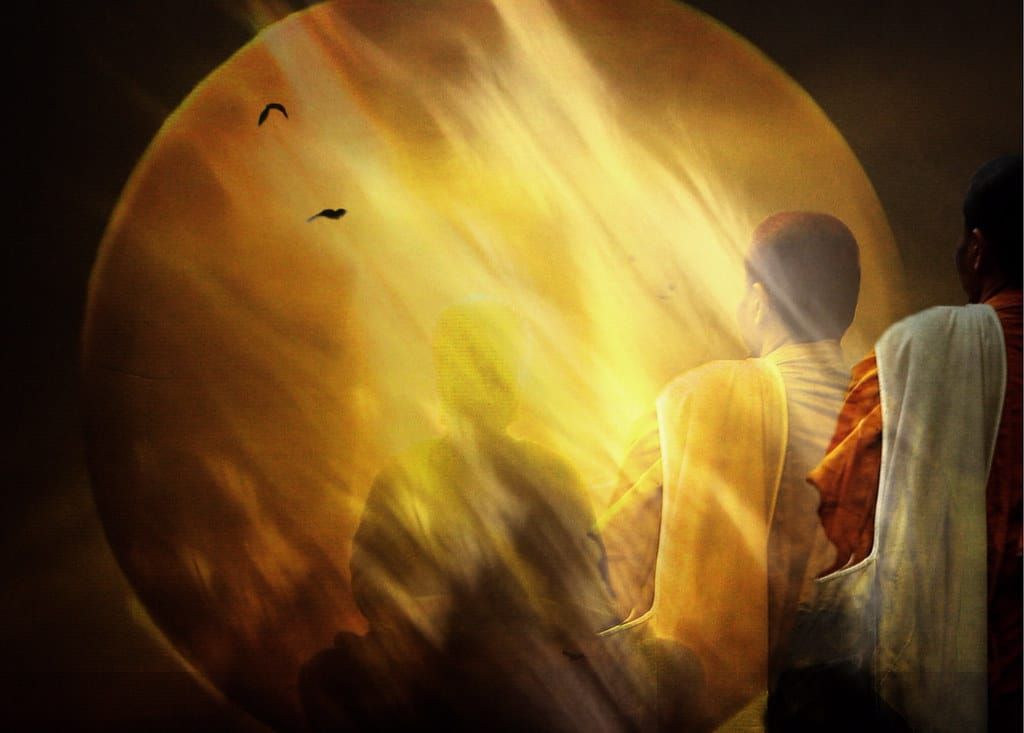
Some people believe in a God. Others believe in nothing at all. And then there are those whose faith does not fit into a dogmatic drawer but lies in a particular way of seeing: people who sense a field, a presence, a more or less intelligent pattern in everything alive, and who still know that it does not need a face to be effective. My approach does not begin with a dogma but with a need: the wish that life is more than a random collection of events. That nature is not just a backdrop but an expression. That people, animals, forests, cities, stars and thoughts arise from the same source: a shared ground of meaning.
The ancient concept of the world soul – Anima mundi – describes exactly this intuition: the world as a continuous network of resonance in which all the individual parts are connected. You do not have to read this in a purely mystical way; it is a poetic metaphor for the fact that psychological processes are never isolated. A society “breathes” together. An individual is like a nerve node in a larger tissue. This view fits my work on trauma, addiction and social fragility. No one is ever wounded alone. Where trauma separates, the world soul connects. My writing constantly moves between these two poles. Addiction, for example, is often a failed attempt to find a hold again in this greater, shared whole. Trauma, by contrast, is a radical interruption of resonance and of what we share, through which the world falls silent. Resilience, then, is the work of restoring this resonance – within me and between us.
What matters to me here: my faith is not only a cosmos, it is also a view of human beings. I believe that we are not simply “good” or “evil,” but connected or disconnected. What people call evil is often, for me, not a demonic special case but a process: splitting off, hardening, dehumanization. When someone loses contact inside – with themselves, with others, with reality – the other person more easily becomes an object. That is exactly why connectedness is not romantic wellness for me, but moral hygiene.
My system has two modes that alternate like light and shadow. In existence mode, when the day is ordered, I think soberly: a personal God is unlikely. Religion explains historically grown needs. There is a field, a larger pattern, but no person with a will of its own. In crisis mode, however, when I am physically threatened or experience mortal fear, a personal figure of God appears. That is not a logical contradiction but rather a psychological pattern: in extreme states, the psyche automatically activates a personal, protective counterpart. For people with C-PTSD, this is not a “mistake” but an answer to a life that had too little to hold on to. The inner alarm calls for an attachment figure, even if that figure exists as an archetype. When I think of the “greater,” it feels like an intelligent field. Not really personal, but perceiving as a whole. We are waves of the same ocean. The divine is not somewhere out there; it is within us.
Jesus fascinates me in this context, but not as the exclusive Son of God. He fascinates me as the Son of Man, in the best sense: a human being in whom the divine was manifested to the fullest. He is a moral archetype of integrity and radical compassion. He shows that the universe can condense in one person without devaluing everyone else. Because of my psychological makeup, I still have the urge to personalize. I cling to the olive-wood cross, love its scent and the reverence of cool church interiors. Whether I am speaking to myself there or to the universe makes no difference to the hold it gives me.
What I reject, however, is religious performance. When God becomes a product and faith becomes a brand, that is not discipleship but self-exaltation. When I translate my faith into an attitude, it is above all this: truthfulness instead of show. Responsibility instead of excuses. Protection for the vulnerable instead of justification for perpetrators. Love, for me, is less a feeling than a decision in small actions: how you answer, how you look, how you set boundaries and how you leave someone their dignity, even when you cannot save them.
Resonance is the heart of it: something answers without speaking. A song or a glance strikes me as if on cue; a decision feels right without my being able to explain it. So that I do not deceive myself, I need practice, not just feeling. I do not tell real resonance from a trauma reflex by how strong something is, but by how it feels afterward. Resonance makes me calmer, clearer, braver. An impulse from trauma – or in general – makes me narrower, more driven, panicky in its certainty. My anchors are banal and still sacred: nature, music, writing, the smell of wood and stone – and sometimes simply breathing until the body believes again that the present does not mean danger.
Into this network of resonance also fits the intuition that energy returns: good comes back at some point. Perhaps not noticeably right away, but in the long run it flows back into the cycle of the whole. Life is a roller-coaster ride: an eternal up and down. You can call it karma, or simply a resonance logic of human relationships. Whoever gives love shapes spaces in which love becomes possible. Whoever sows trust invites trust. This is less a cosmic bookkeeping than a tendency in the web of our relationships.
The same goes for the power of inner direction. Whether I call it praying, visualizing or manifesting: when I direct myself toward a goal and believe that the greater can make it happen, it changes my whole disposition. Psychologically, this belief dissolves the inner resistance that otherwise blocks me. Spiritually, it feels as if I am reconnecting. Faith moves mountains, as Jesus said – not through magic, but because the deep conviction that the universe is “playing along” enables us to grow beyond our blocks. I deliberately connect psychology and spirituality here: I know that prayer is also self-regulation and that images of God can be projections. But that does not make them untrue.
For me, the hardest question remains suffering. I do not believe that pain “has to be this way” in order to be good. Some things are simply destructive. When I speak of meaning, then not as an explanation from above but as work from below: meaning arises when, out of what broke me, I still make something that does not break again. That is why forgiveness is not a spiritual shortcut. Boundaries are not the opposite of love; they are often its precondition. I can see the human in someone and still say: No. This far and no further.
Finally, there is the impossibility of disappearing without a trace. That someone should simply be “gone” after a life full of injury and courage would be unjust. I do not know whether “I” continue to exist in the sense of a stable core self. But I find it hard to believe that everything that makes a person falls entirely into nothingness. Perhaps what remains is not identity but relationship. Perhaps what remains is not the ego but a trace. For me, the wish to leave something behind is a healthy answer to a childhood in which I often felt invisible. My legacy is meant to be proof that I will no longer let myself be pushed out of the world. Eastern perspectives flow into this view: the Tao, non-duality, yin and yang. Separation is an illusion; we are part of a single, connected being.
I can hold these ambivalences. I can pray and doubt at the same time, think psychologically and feel spiritually. That is not a weakness, but rather an ability I have worked hard for: holding tension without fleeing into dogma or cynicism. My faith is not a finished system but an open process: a world that does not noticeably speak, but answers. And a field that carries me for the long haul.
Originally published in German as “Spiritualität der Resonanz – Zwischen Feld und Figur”. English version by Dorian Rammer, translated with AI assistance.